
2026S Design a Chair

  • 29.04.26

    By

    Angela Neubauer

  • feedback 29.04.2026

    By

    Eva-Maria Lainer

    feedback 20.03.2026

    • watschnmann prater
    • context? public? private?
    • different types of anger => which part?
    • experiments: questions, levels of anger, specific/personal moments, …
    • power dynamics => people in leading/higher positions can feel anger more freely => differences between women and men
    • »triangle of sadness« movie
    • painting? => maybe not an object?

    »… all women who are powerful in the public imagination have placed onto them images of monstrosity, or are imagined as monstrous underneath their exterior appearance …«


    female rage in art: past and present

    • elisabetta sirani: independent painter by 19 in bologna (17. century); died mysteriously at 27; opened painting school were she trained many women; famous for painting very fast and clean; painted »timoclea killing her rapist (1650)« => putting women in powerful positions against men in powerful positions
    https://en.wikipedia.org/wiki/Elisabetta_Sirani: feedback 29.04.2026
    • valie export: deconstruction of the female body; liberation of women from imposed chains; abstract and hidden voyeurism suddenly becomes tangible and visible (tapp- und tastkino); the body as an political instrument

     the role of women in society—as mothers, as bearers of children, and as wives—is justified through the biological functions of their bodies. according to VALIE EXPORT, only when women detach their identity from their bodies can they exist as self-determined individuals.

    • louise bourgeois: famously said anger was what made her work; she treated anger as a tool, not a problem


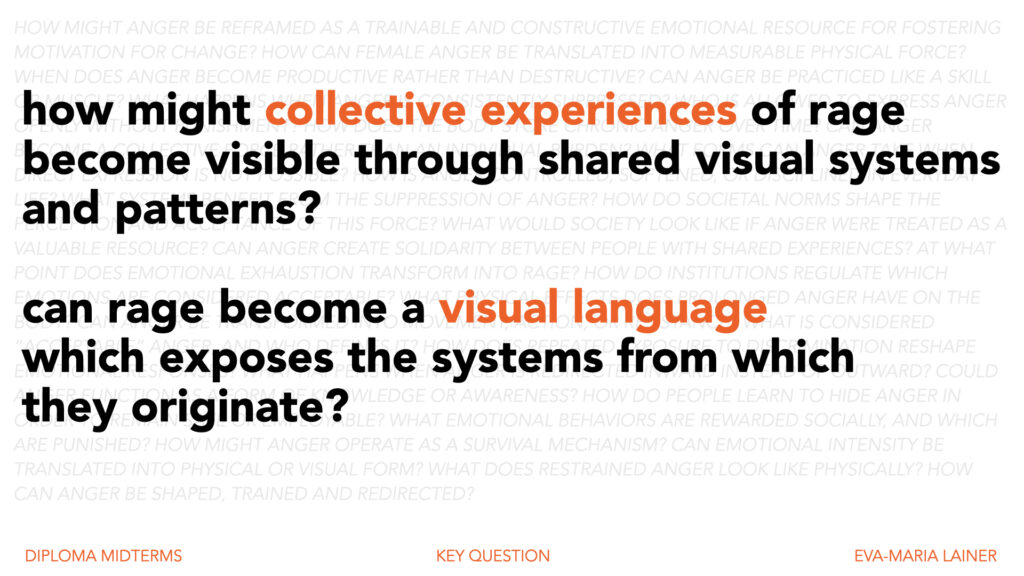
    how might anger be reframed as a trainable and constructive emotional resource for fostering motivation for change?

    how can anger be shaped, trained and redirected?

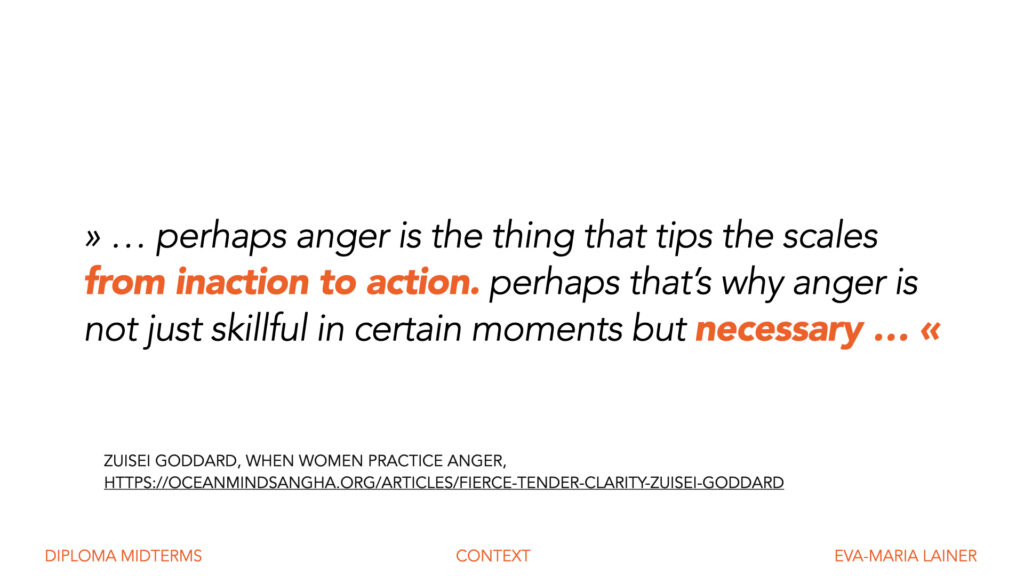
    … perhaps anger is the thing that tips the scales from inaction to action. perhaps that’s why anger is not just skillful in certain moments but necessary …

    Zuisei Goddard, When Women Practice Anger,

    https://oceanmindsangha.org/articles/fierce-tender-clarity-zuisei-goddard

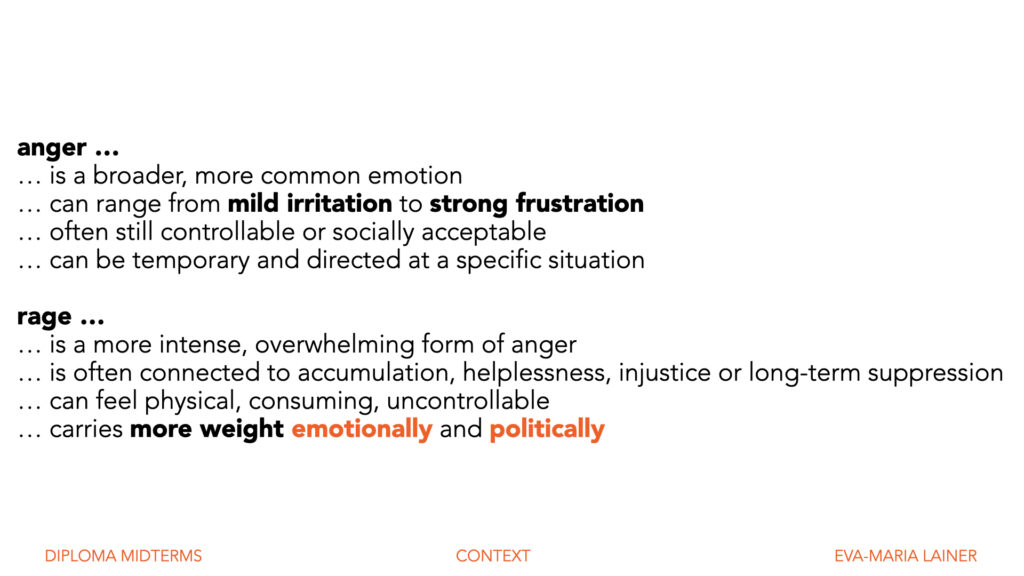
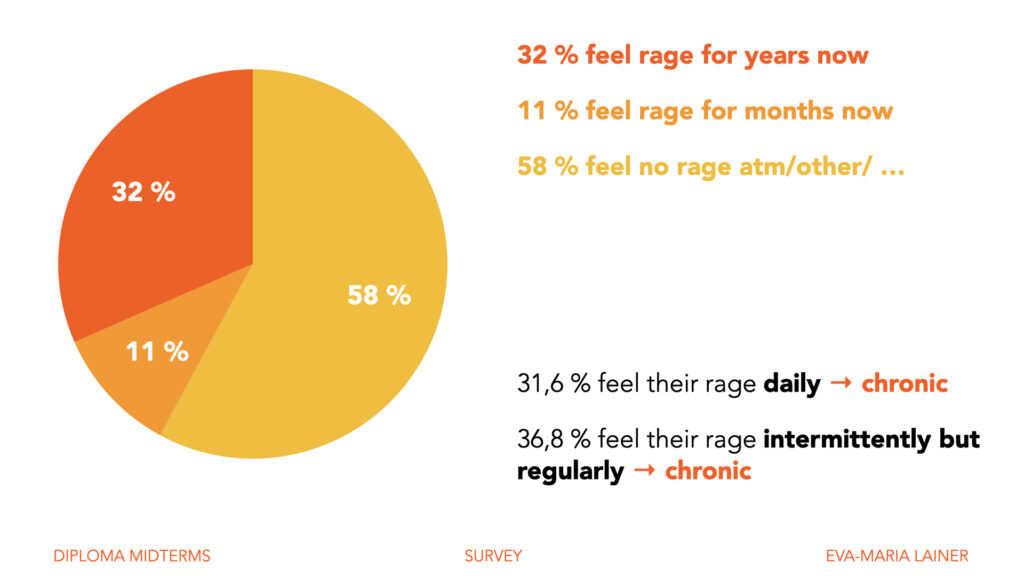
    chronic anger (type of anger I am working with)

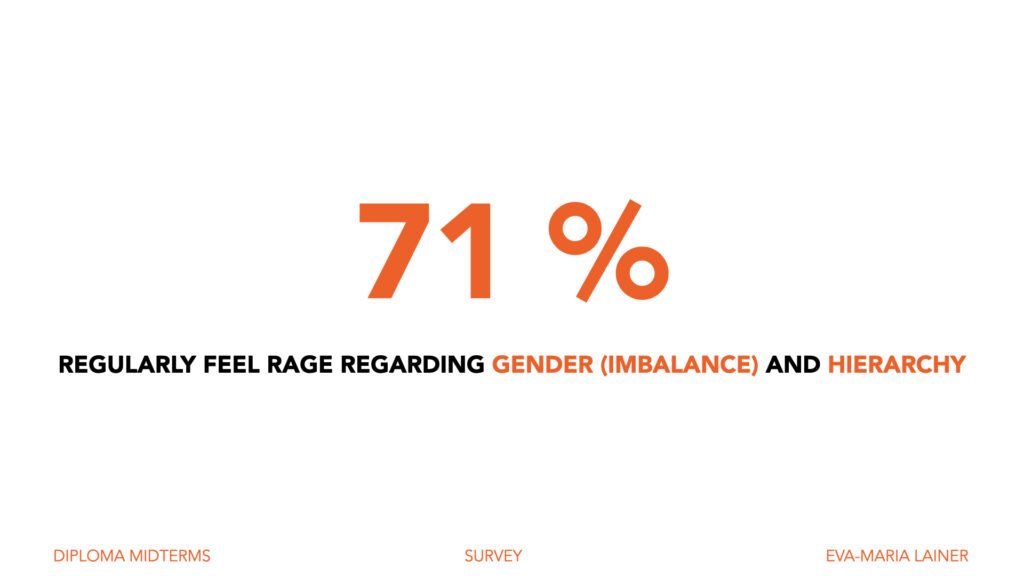
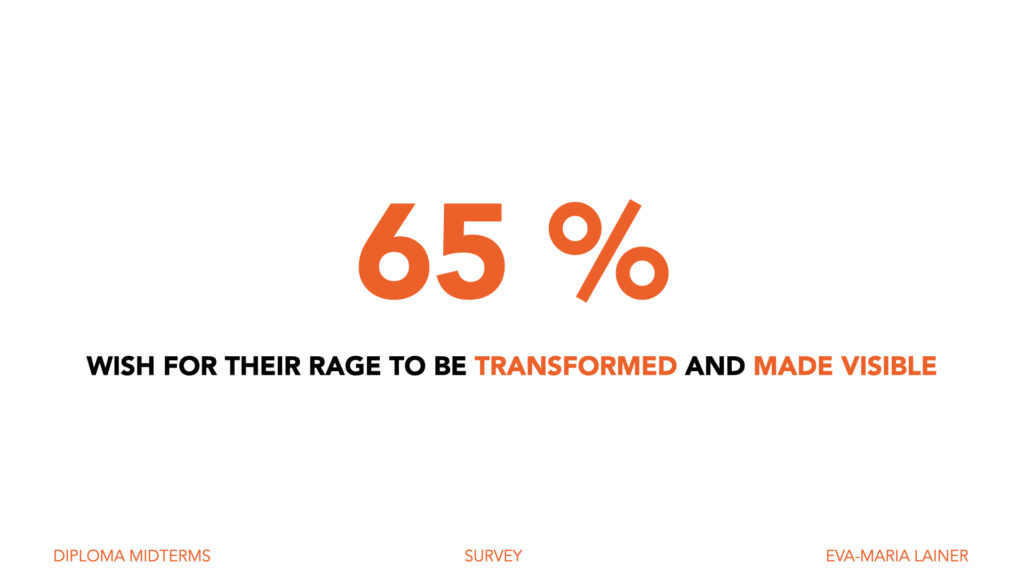
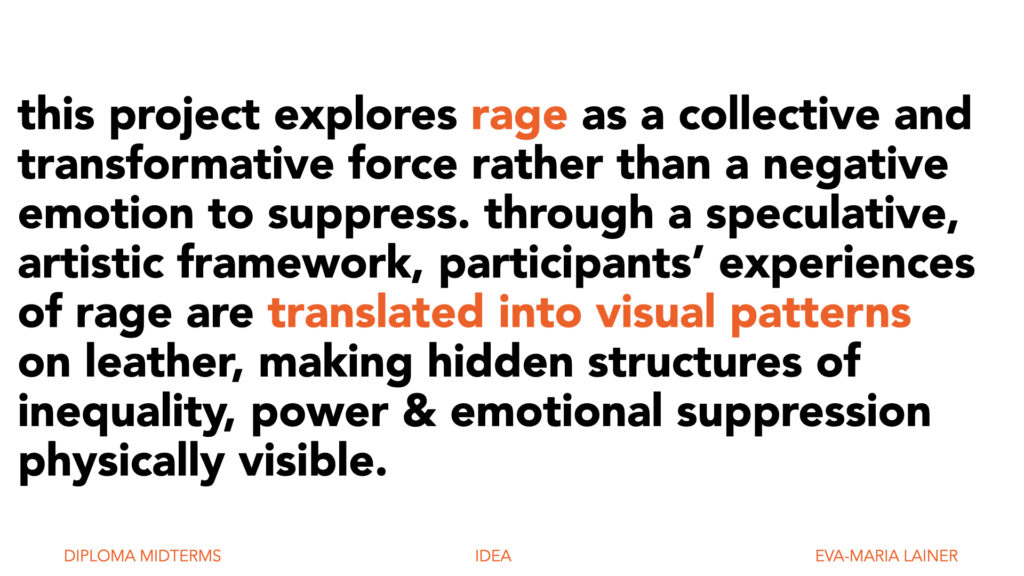
    feminist/female anger becomes chronic because it is continuously reactivated by persistent structural inequalities rather than isolated events.

    chronic anger (frustration) → productive anger (motivation)

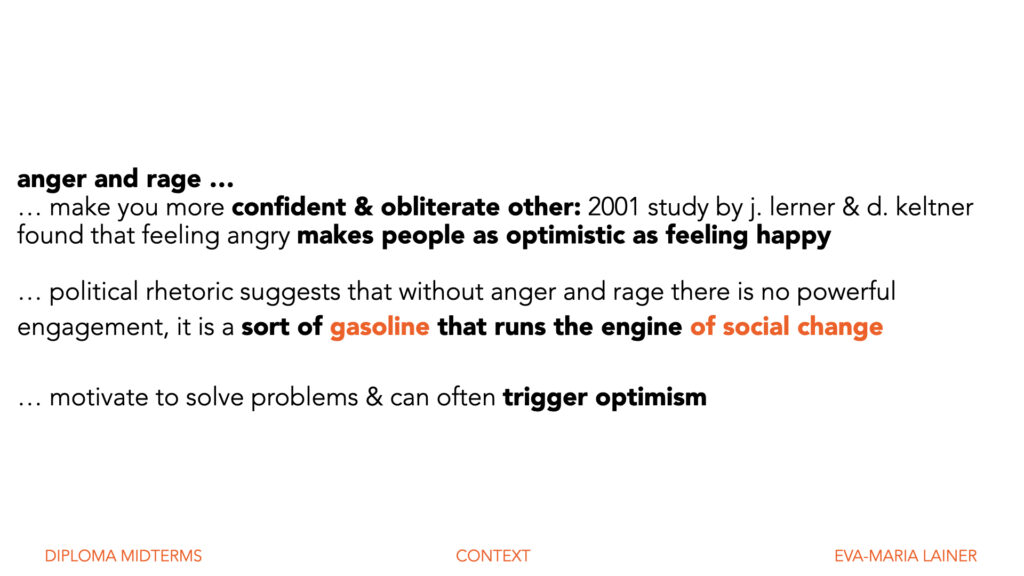
    anger can trigger optimism and is a motivator

    anger becomes a method of making || anger as a resource

    → psychological thinking: anger is an activating emotion (it generates energy, focus and a drive to act)

    → in emotion regulation theory, anger becomes useful when it is processed, reframed and channeled, not simply released

    → practicing anger, just like practicing happiness → anger desirable feeling, just like happiness


    chronic anger spreads through the body in wave-like patterns; it is not punctual, but continuously in motion. it is not something that can be put aside, but remains as a second skin—part of our perception and our actions.

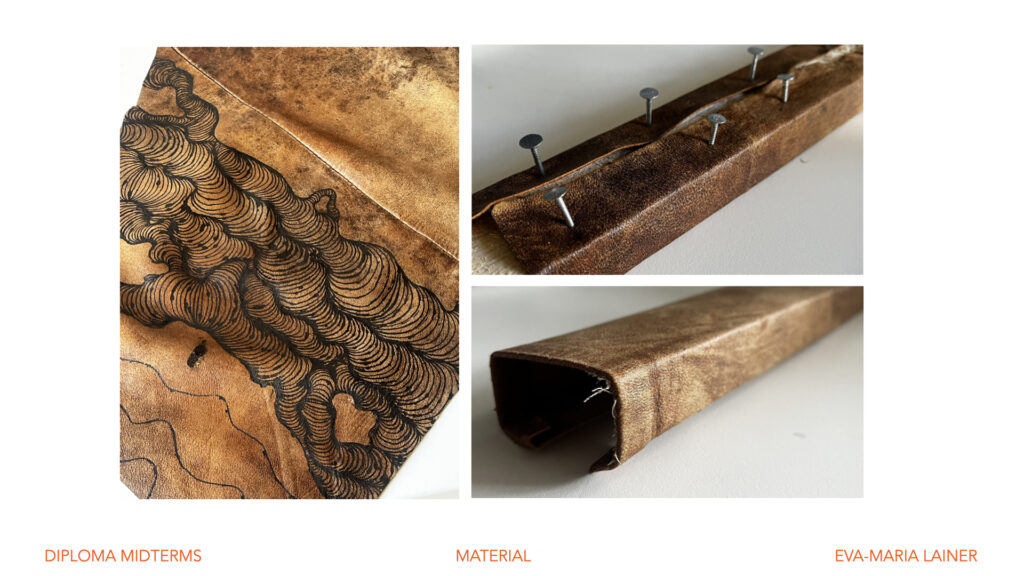
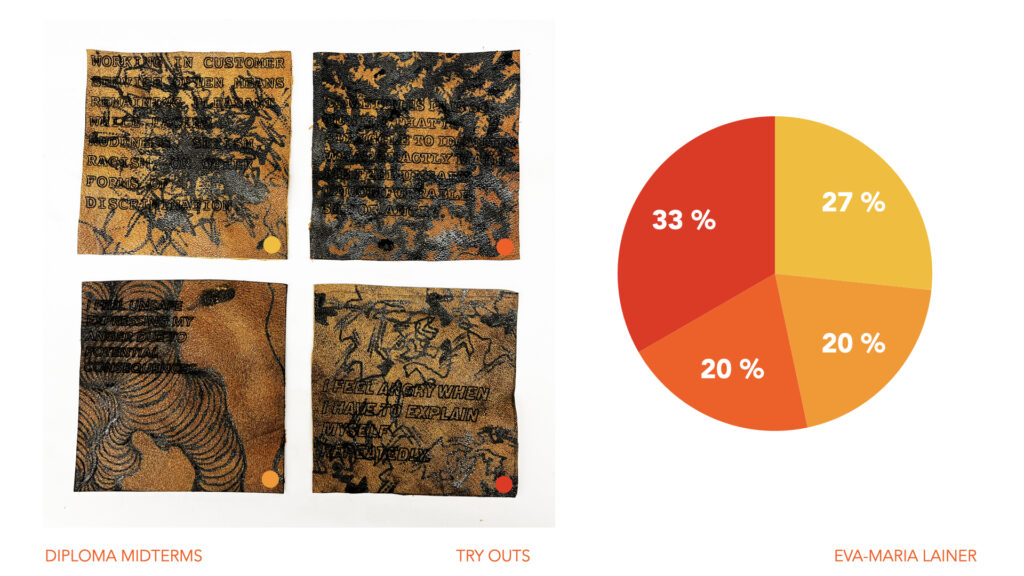
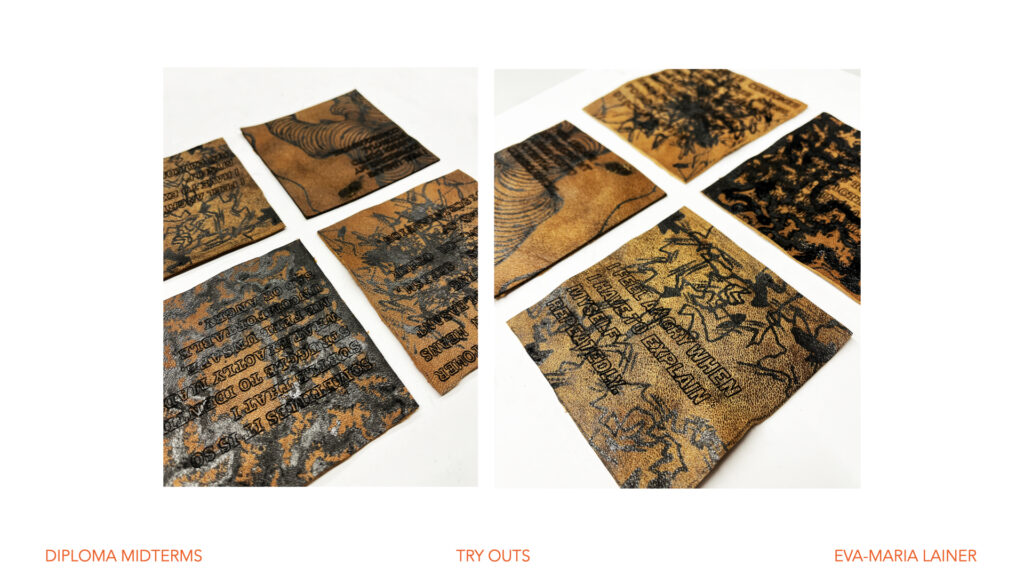
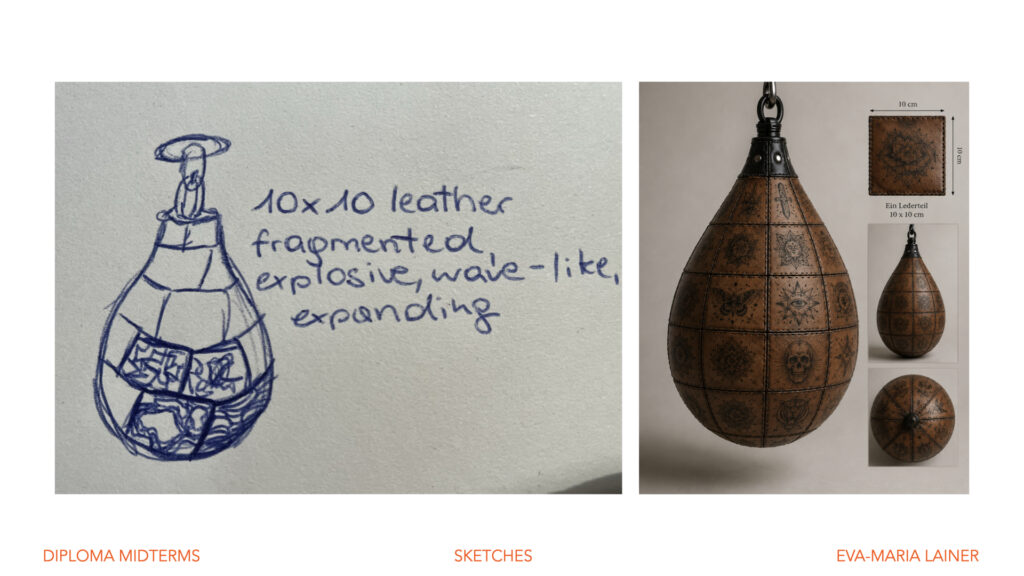
    try out: ink on leather
    leather representing skin/body
    ink in wave-like pattern representing permanence of chronic anger in and on our body

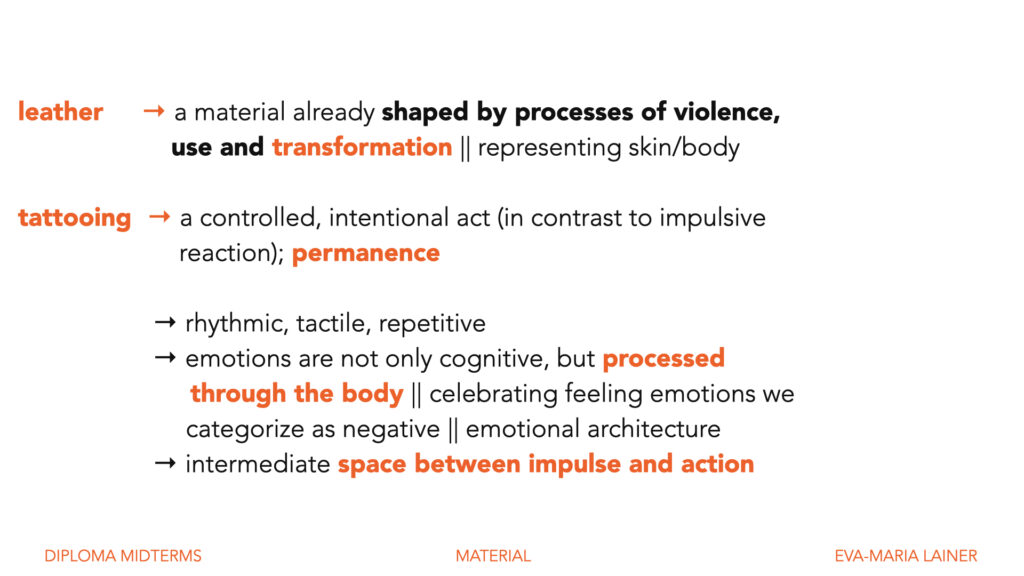
    leather → a material already shaped by processes of violence, use and transformation

    tattooing → a controlled, intentional act (in contrast to impulsive reaction); permanence

     rhythmic, tactile, repetitive  emotions are not only cognitive, but processed through the body // celebrating feeling emotions we categorize as negative

    repetition / ritual → training rather than catharsis (→ filming process) // repetition as emotional architecture—it structures feeling(s) over time

     intermediate space between impulse and action

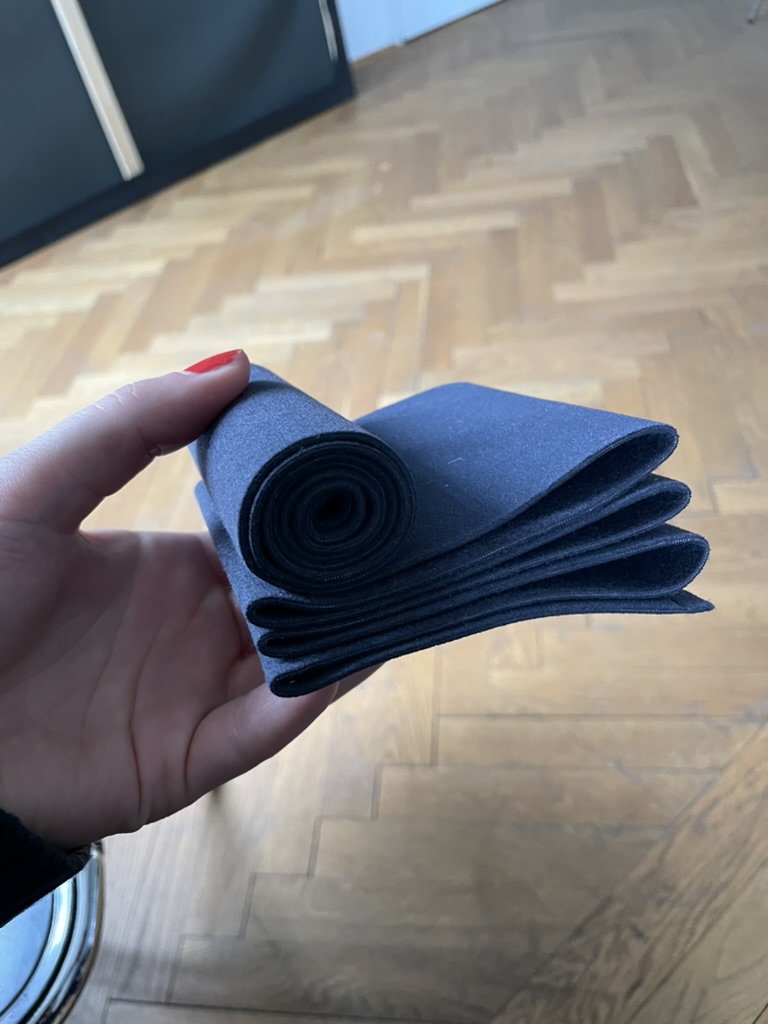
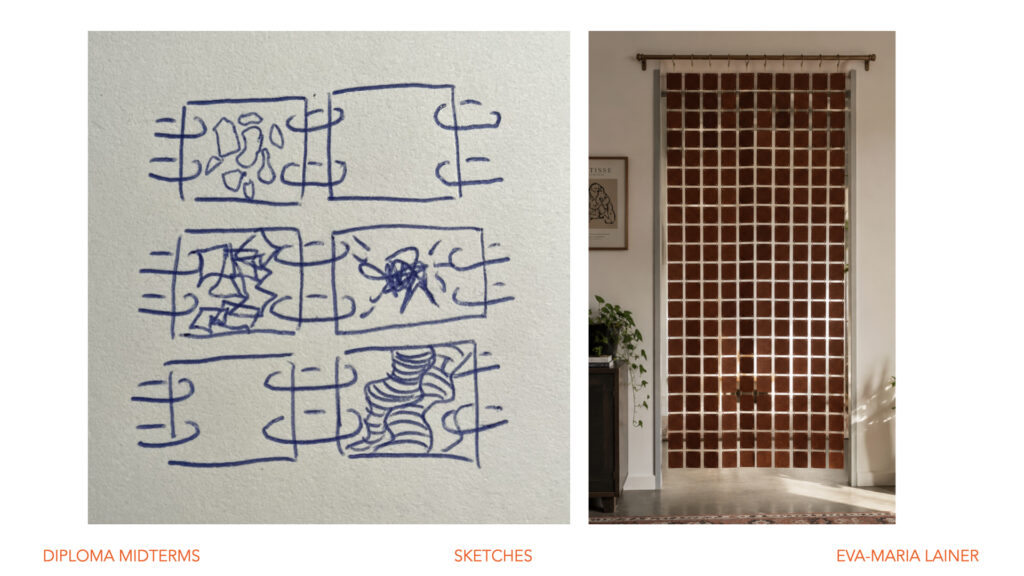
    try out: wet forming leather

    … anger is the deepest form of compassion, for another, for the world, for the self, for a life, for the body, for a family and for all our ideals, all vulnerable and all, possibly about to be hurt. stripped of physical imprisonment and violent reaction, anger is the purest form of care, the internal living flame of anger always illuminates what we belong to, what we wish to protect, and what we are willing to hazard ourselves for

    – Consolations: The Solace, Nourishment, and Underlying Meaning of Everyday Words

    bode senior cord; organic shapes; patina; (alternative) leather; wearable; tension; wet forming; ink; …

    further steps // what I want to achieve with the project // questions // …

    – filming process  intentional, repetitive act // same spot, …  coming up with a practice // anger becomes a method of making

    – wet forming try outs // more complex forms  intentionally shape anger (?)

    – is anger truly transformed—or just aestheticized?

    – does the project need to be finished? ever-growing?

  • 24.04 Tutorials

    By

    Apolonia Bokszycka

    Throne design

    • Unique, singular chair
    • Raised above floor level
    • Ceremonial purpose

    Maybe in order to humiliate the person intended to sit on it, a series of identical thrones should me made? An anti-thesis to the definition of a throne.

    Who am I designing for?

    Technolords are out of reach. I cannot interact with them – maybe it would be more interesting to design for people enabling the technolords or just general public – in order to remind them about their political power?

    Fragment of an essay “Silicon Valley’s Worldview Is Not Just an Ideology; It’s a Personality Disorder” by Maria Farell
    Idea: Providing general public with instructions how to make a throne themselves.

    Framework

    This semester I would like to learn working with metal.

    The NY Chair 1 by Malcolm Ransom, 6.35mm aluminium
    Another way of humiliation would be to create a throne from an everyday object.

    Next step: visiting Altmetall

  • Tutorial 24.04.26

    By

    Nina Heimel

    Form studies

    –> having pillows with imprints to give a direction how to use it?

    more sketching

    Rhino model 1

    –>first model still ball-shaped

    Rhino model 2

    A chair that not only supports stimming but gives it a stage threw drawing the motion (inspired by a ball pen)

    –>second model less ball shaped

    rounded edges at ball bearing touchpoint

    I did some research and realized that I can’t realistically build this

    New mechanism ideas:

    1) inspired by a gimbal

    –> but instead suppressing motion enabling it

    How do I implement drawing the motion?

    2) back to ball joint

    –> using steel elements attached to the seat to draw the motion

  • 24.04.2026 Tutorials

    By

    Clark Philips

    Objects and Spaces communicate unspoken rules

    HOW CAN WE WORK WITH UNSPOKEN RULES?

    • A chair is not neutral
    • Sitting is not passive
    • Space is not open—it’s structured

    “We don’t just use objects – we interpret them.”

    “A space can be physically accessible but socially restrictive.”

    Inspiration

    Peer feedback session 22.04.2026:


    -Just sitting is not enough to occupy space.

    -Unspoken rules of sitting is most interesting.

    -Documenting the process.

    ‘While making the mold of the stairs from the Strauss monument. I was using clay to make the imprint and it was reminded that an action is required in a way to be in space you don’t typically sit on.’

    NEXT STEPS

    -Site Specific documenting and investigation

    -Material testing and development of aesthetics and visual language

    -How much of the process or the moods should be included in the project?

  • Passing on -> Holding Together

    By

    Emma Breitenecker

    Key elemtents: empowering each other, solidarity, working together, holding together, passing on, sharing

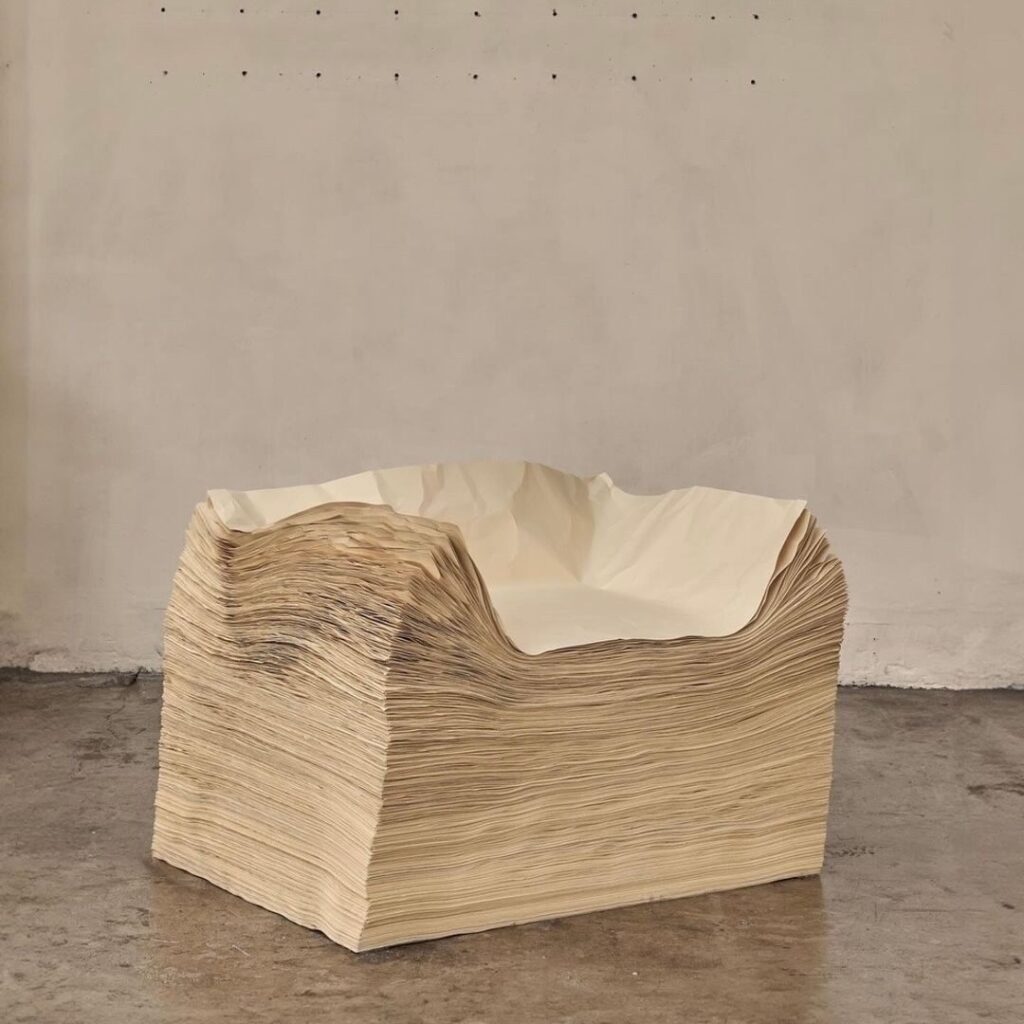
    Where I came from: layers

    Layers: Stacking chairs

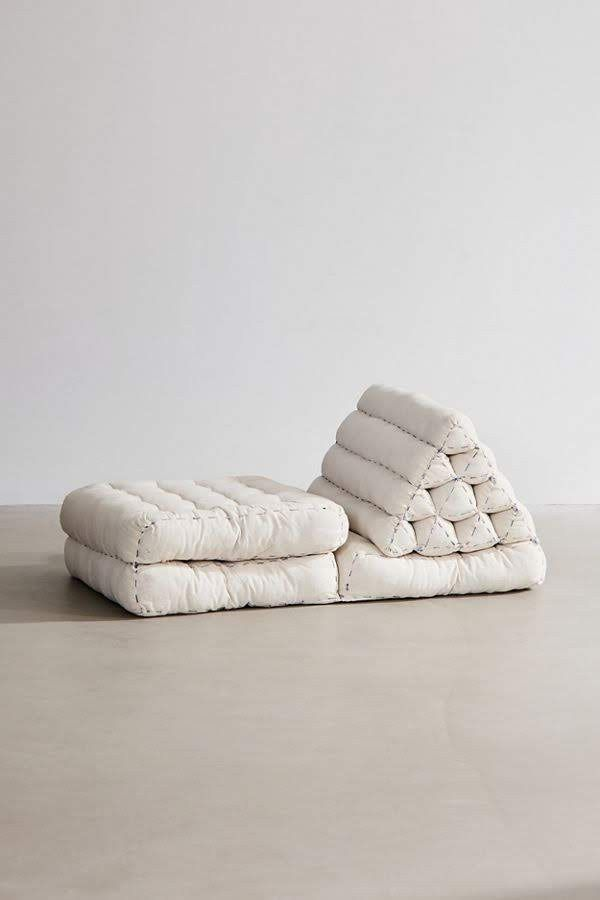
    Tatami seating – The Zaisu Chair

    Stacking Mechanism like DimSum-steamers or LEGO

    => Stacking chair, no legs, stackable back/armrests. Sitting is possible on each single one, on some or on all

    Symbolisms:

    1. One high or many low: keeping all (height-)privilege for power or sharing seating elements for non-hierarchical equality
    2. Eye-level: possibility of changing the height of each chair so everyone at the table can eventually sit at the same level (same height party)
    3. Empowerment/Solidarity: Sitting on each other’s shoulders, supporting and trusting each other – positive or negative (also: man-monster-theory)

    Research: Female designs

    Embroidery, Floral patterns, Pink/red tones, curvy, soft

    Bokja – women,women, women; Anna Aagaard Jensen – untitled chair; Laia Laurel – Anti-manspreading chair; Tania da Cruz – Playmobilia; Gaetano Pesce – Up5/Donna

    Sketches & first small models

    First draft in Rhino

    My approaches to make my chair speak “woman”:

    Going for words

    Stitch something onto the edge/bordure

    (Leopoldine – my great great grandmother, Tricoteuses, Casdagli, Katharina Cibulka – Solange/aslongas)

    Second draft in Rhino

    sentences, “riddle”

    Questions:

    • What path do I take to make my topic clear to the audience? Primarily through material and colour/
      stitching in (riddle-like) words and sentences/
      a feature in the shape (corset binding, backrest shape)/
      by showing a setting or purpose for the chair (workshop etc)
    • Do I take the positive route of empowerment (feminism) or the negative (man-as-monster)
    • Feasibililty – what can I make, what do I have to buy
  • Feedback 24th of April

    By

    Anton Haberl

    a rocking massage chair

    based on feedback from midterms, a new design for fulfilling the idea of having a chair that includes active interaction, consoling touch & constant motion without the need of constantly pushing a pedal with ones feet.

    Simplistic model to visualize mechanical solution

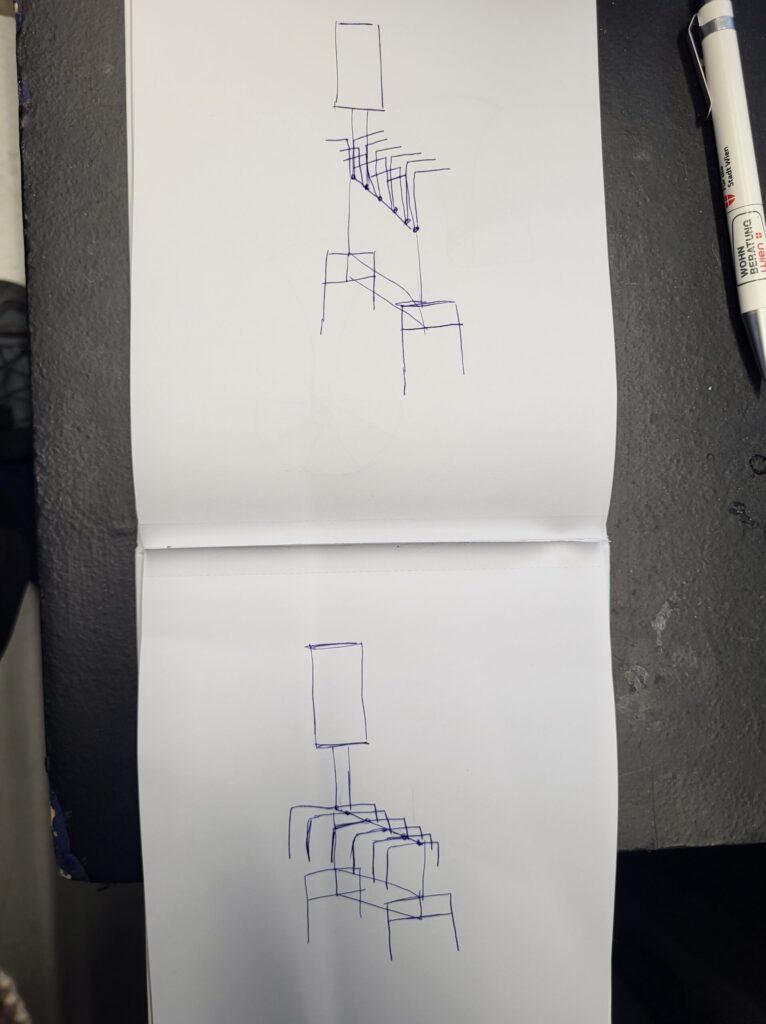
    A pulley connected to the rocking chair is powered through the back and forth motion of the chair itself, by a lever fixed to the floor. This pulley powers massage rollers on the back of the chair via a belt.

    Pulleys and timing belts exist in variable sizes and can be matched to the required distances of the contraption.

    Inside of the pulleys bearings will be installed to connect rods to the corresponding parts such as the massage wheels.

    message wheel concept

    The message wheels are planned from wood, to have a natural material which is supposed to give a pleasant feeling on touch while being easily shapeable.

    Aesthetics

    scandinavian rocking chair

    Scandinavian Lounge Chairs

    Further Steps

    • Have a chat with Matthias about car parts
    • Figure out the exact placement of the message rollers in relation to the human body
    • Meeting with Boris Odehnal (Head of Geometry Institute of Angewandte) for calculation of distances for the contraption
    • Design pleasant aesthetics keeping a balance between comfort and technicality of the design
  • Week 3-7

    By

    johannes_lotze

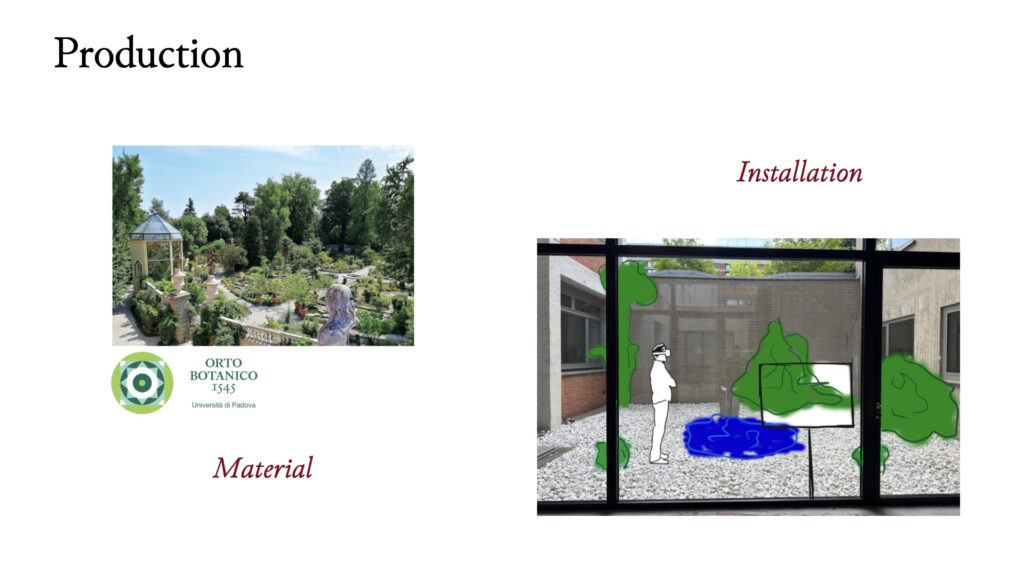
    Intertwining the Physical World with Digital Overlays

    photogrammetry demo aligned to stair case.
    audio playing inside the frame.

    learning:

    1. physical interaction is fun
    2. embrace the weirdness
    3. aesthetics is very important

    Research


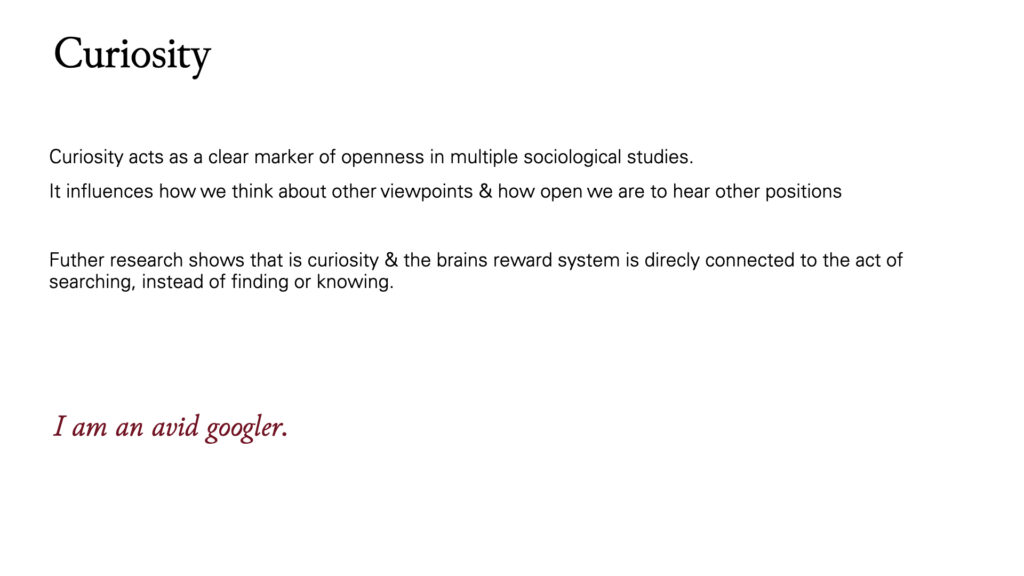
    Studies show:

    • self-assessed curiosity is a marker for openness
    • curiosity is enhancable
    • the interesting / satisfying part is searching, not knowing the answer

    Difference between Neugierde, Curiosity, and Wissenslust

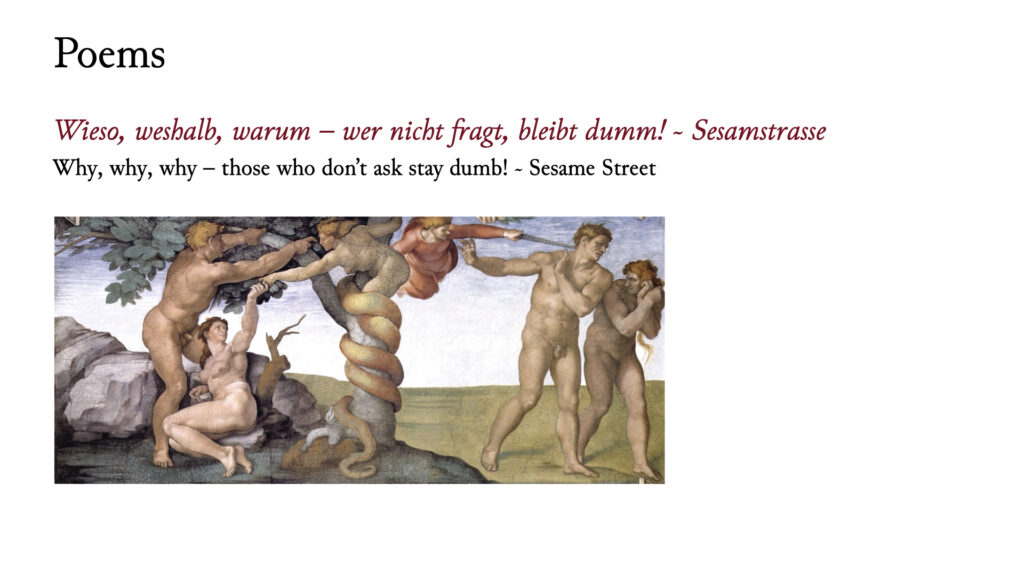
    • Curiosity as (part of) the Original Sin in Christianity
    • Box of Pandora etc.

    >> Vast amounts of literary examples for curiosity being a bad thing.

    >> Over correction in Adulthood, leading to not being curious enough


    Visual Exploration

    What do I want people to leave with:

    “To be supported in their search.”

    “Seeking answers that suit their interest.”

    “Learning beyond just knowledge. “

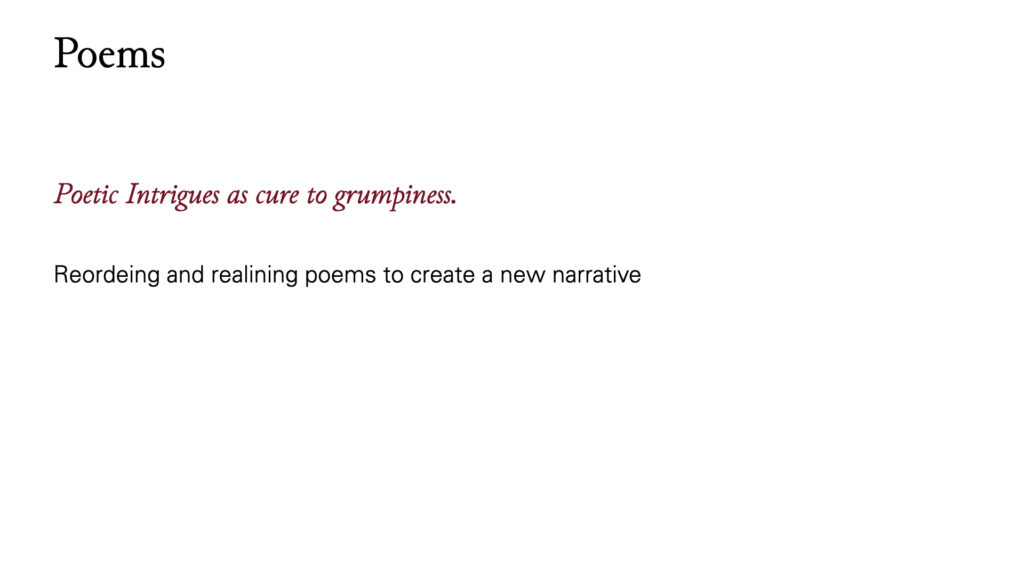
    Poetic Intrigue as an answer to “How to not become grumpy”

    Romanticism; attitude or intellectual orientation that characterized many works of literature, painting, music, architecture, criticism, and historiography in Western civilization over a period from the late 18th to the mid-19th century.

    Romanticism emphasized the individual, the subjective, the irrational, the imaginative, the personal, the spontaneous, the emotional, the visionary, and the transcendental.

    (Encyclopaedia Britannica)

    Poetry:


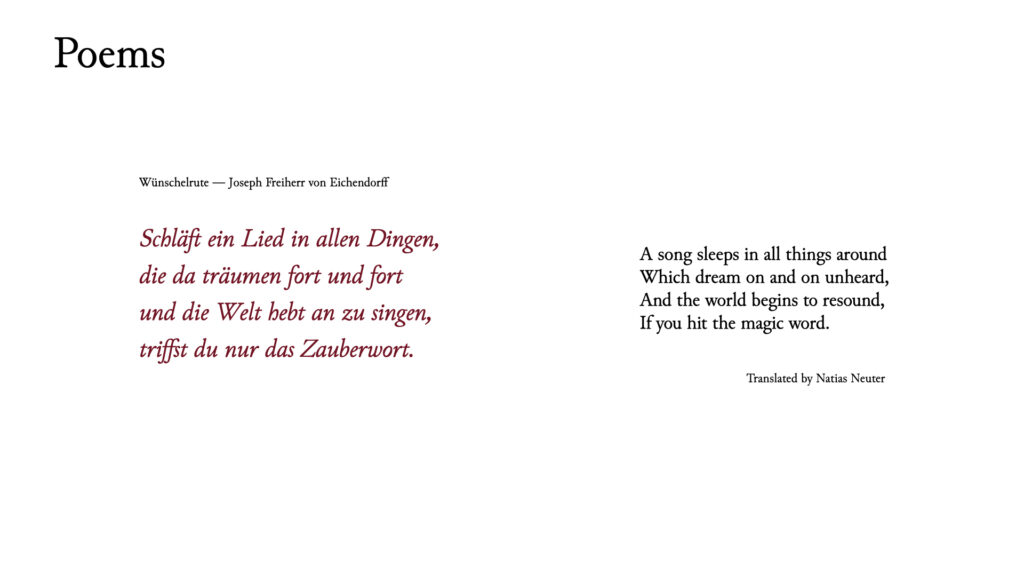
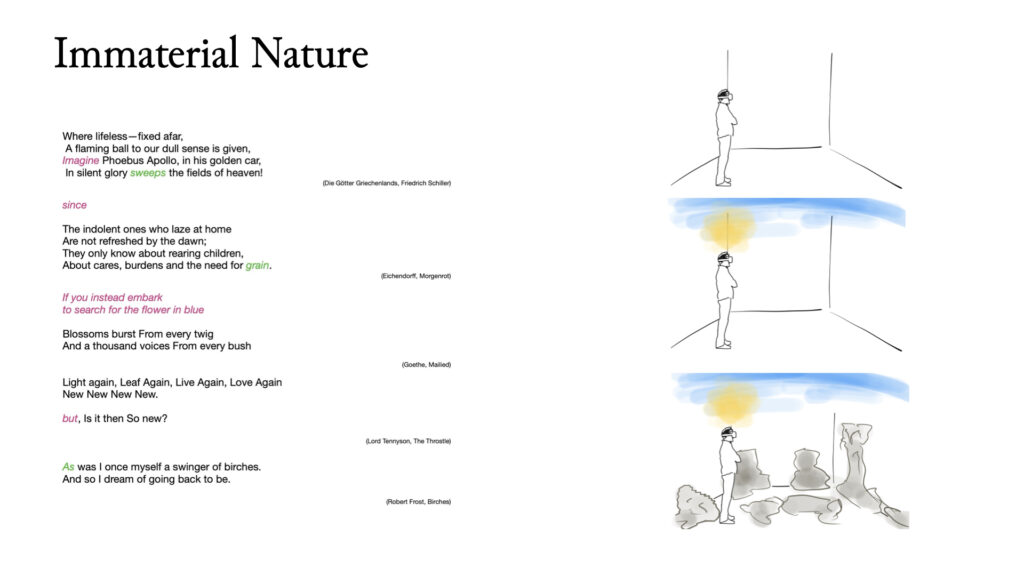
    „Schläft ein Lied in allen Dingen,
    Die da träumen fort und fort,
    Und die Welt hebt an zu singen,
    Triffst du nur das Zauberwort.“

    A song sleeps in all things,
    That dream on and on,
    And the world begins to sing,
    If only you find the magic word.

    Wünschelroute, Eichendorff


    „Wo jetzt nur, wie unsre Weisen sagen,
    Seelenlos ein Feuerball sich dreht,
    Lenkte damals seinen goldnen Wagen
    Helios in stiller Majestät.”

    Where now, as our sages claim,
    Only a soulless fireball rotates,
    In those days, in silent majesty,
    Helios steered his golden chariot.

    Auszug aus Götter Griechenlands, Schiller


    古池や蛙飛びこむ水の音

    an ancient pond / a frog jumps in / the splash of water

    Matsuo Bashō


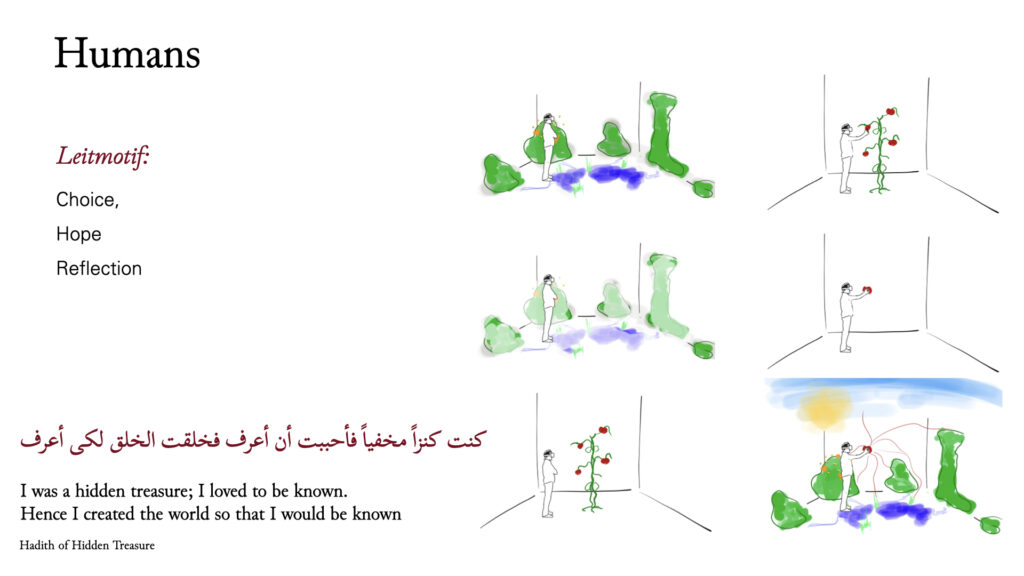
    کنت کنزاً مخفیاً فأحببت أن أعرف فخلقت الخلق لکی أعرف

    I was a hidden treasure; I loved to be known. Hence I created the world so that I would be known

    Hadith of Hidden Treasure


    Drawings while reading. Simple Emotions:


    Going Forward:


    > Fragments of Poems, knowledge etc bring garden to life

    Cento / Found Poem

    >> reassembling parts of poems to create a new whole

    >> assembling knowledge to tell a story / create a space


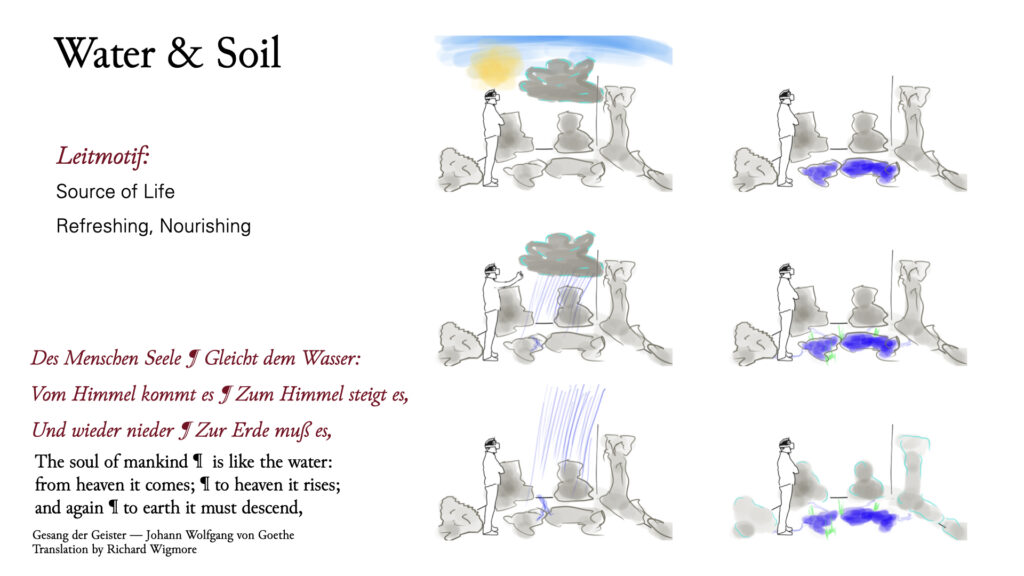
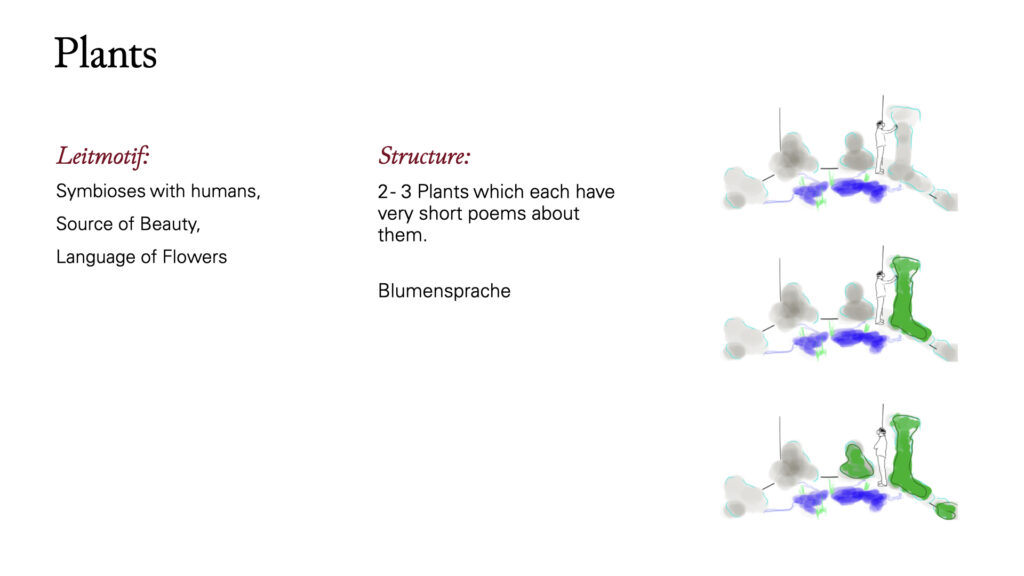
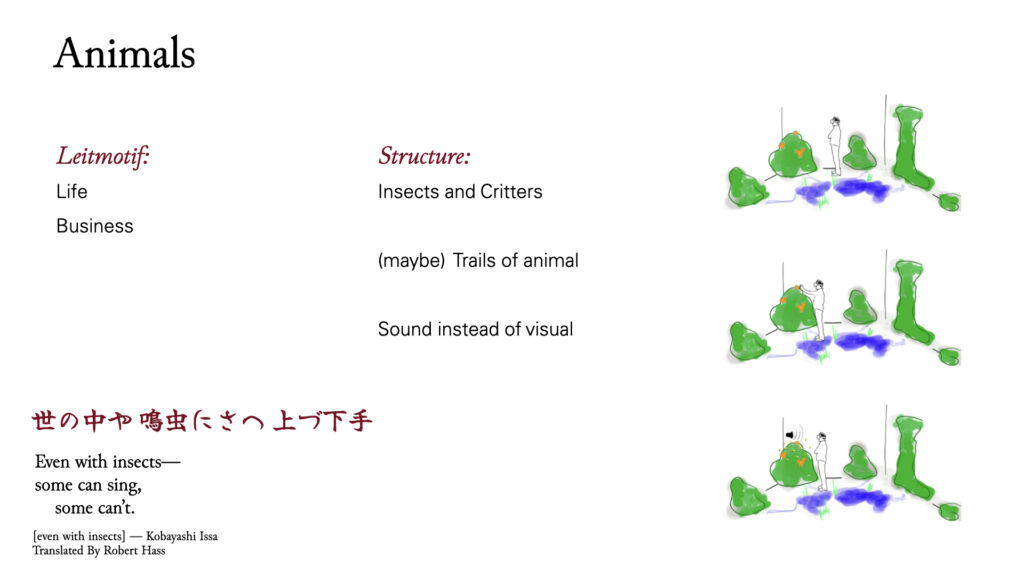
    Currently 5 Areas:


    “Immaterial Nature” — Sky, Weather, Sun, Day/Night

    Beginning, Awakening
    Light, Sun, Spring, Summer.


    “Water” — Soil, Pond, Rain

    Source of Life
    Refreshing, Nourishing


    “Plants” — Plants, Crops, Grass

    Symbioses with humans,
    Source of Beauty,
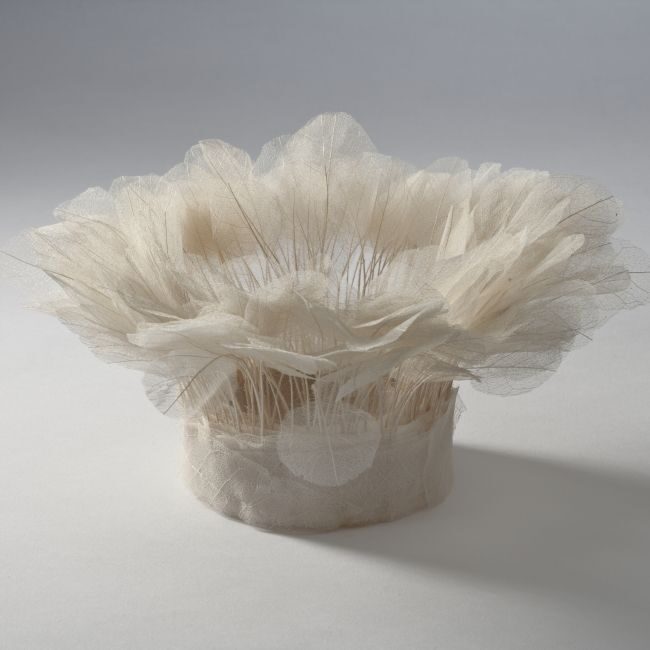
    Language of Flowers

    “Animals” — Birds, Critters, Insects

    Life,
    Business

    “Humans” — Visitors own role.

    Knowledge,
    Hope
    Reflection


    Next Steps:

    – Finalize Poems & Other Knowledge
    – Pick out specific plants / objects / animals etc.
    – Scan

  • Team 8 – 22.04

    By

    Stephanie Rentschler