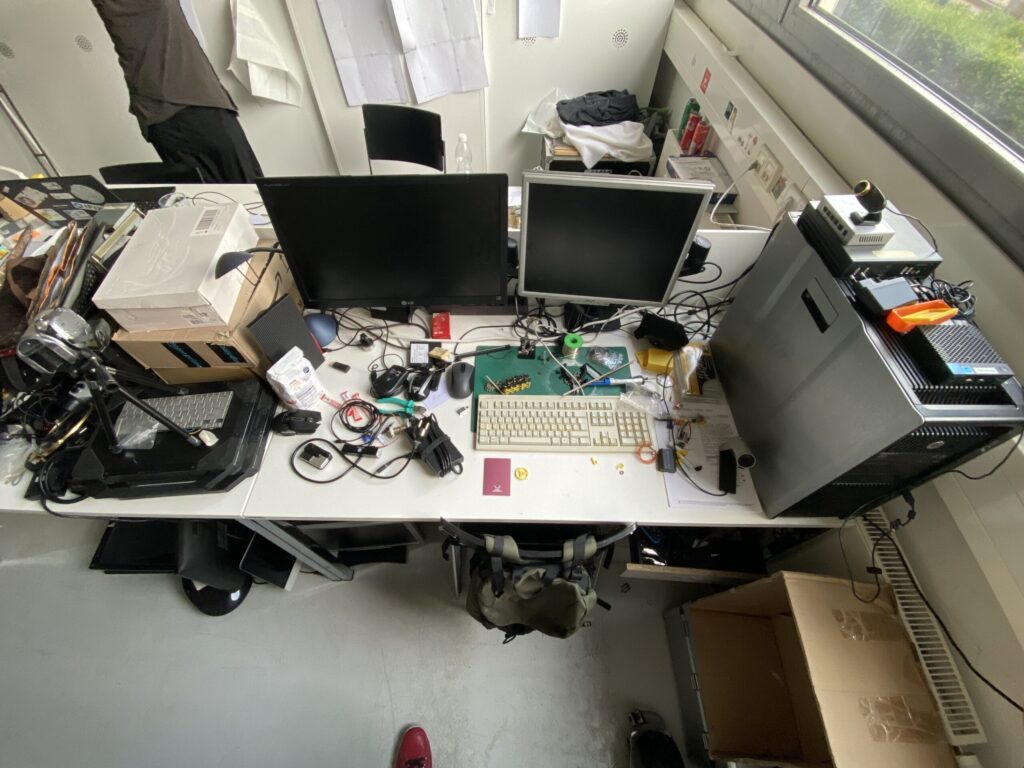
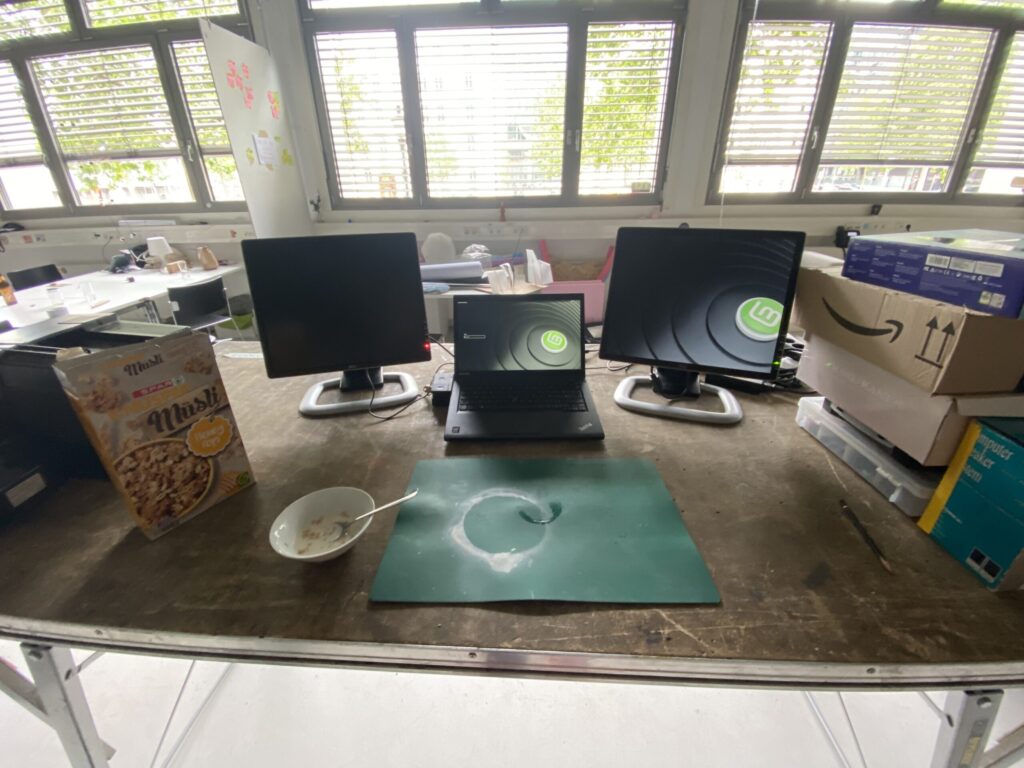
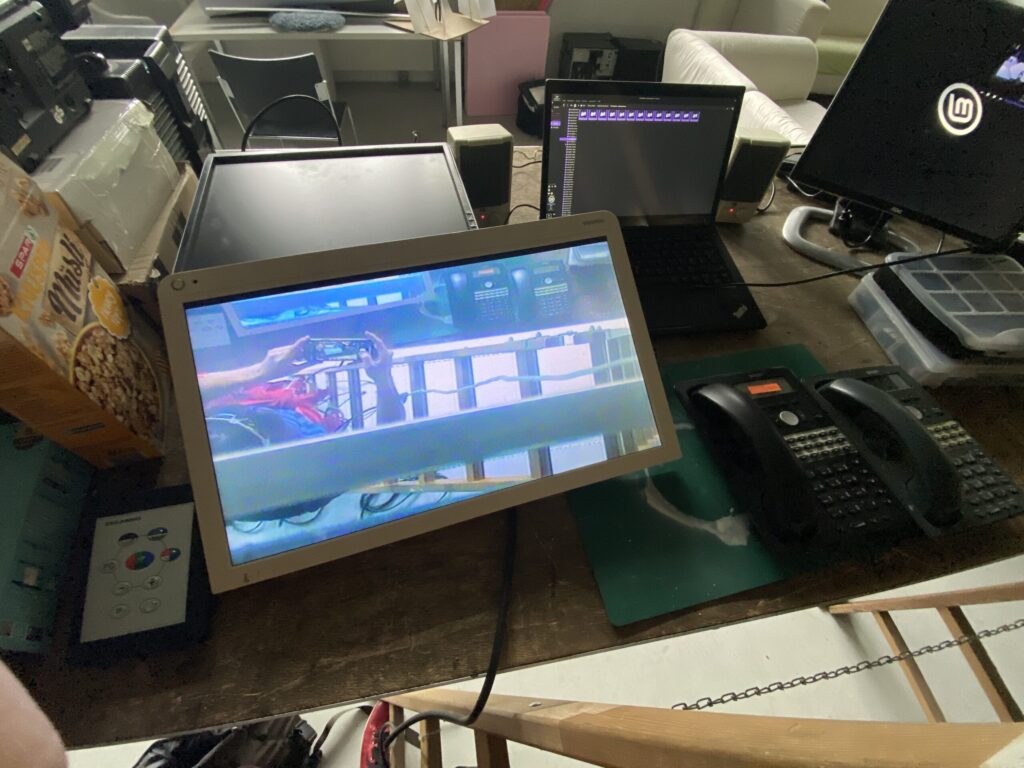
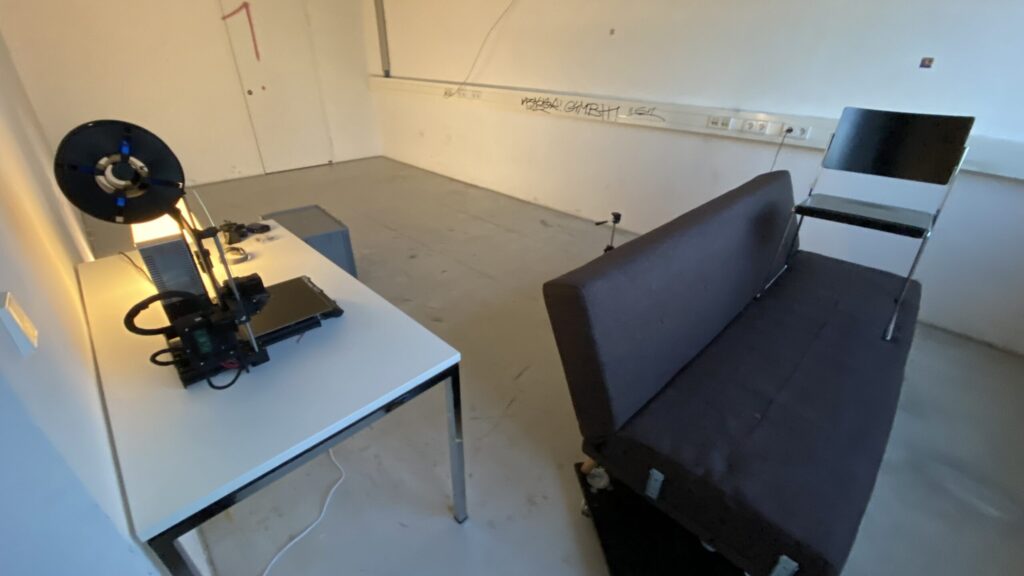
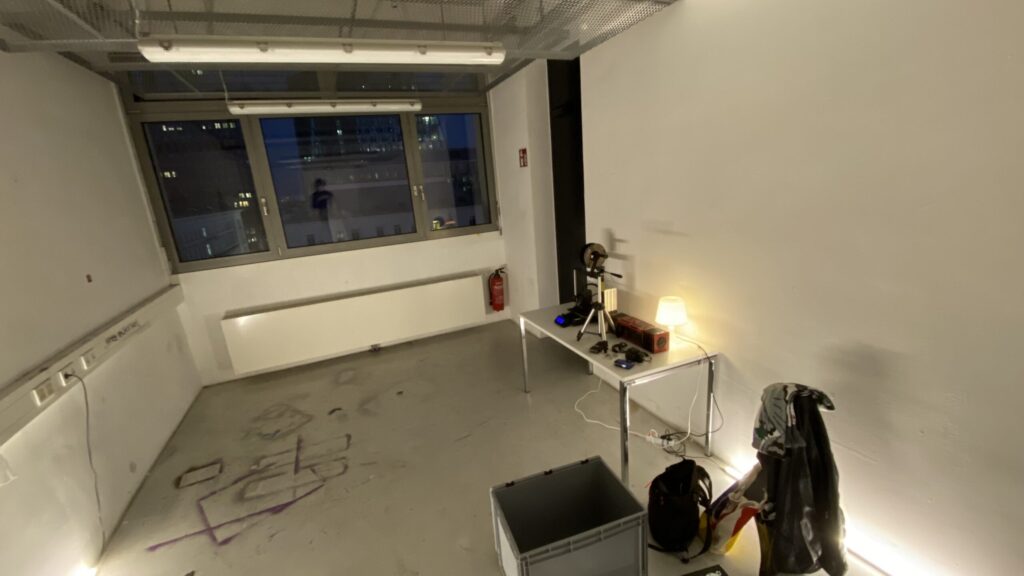
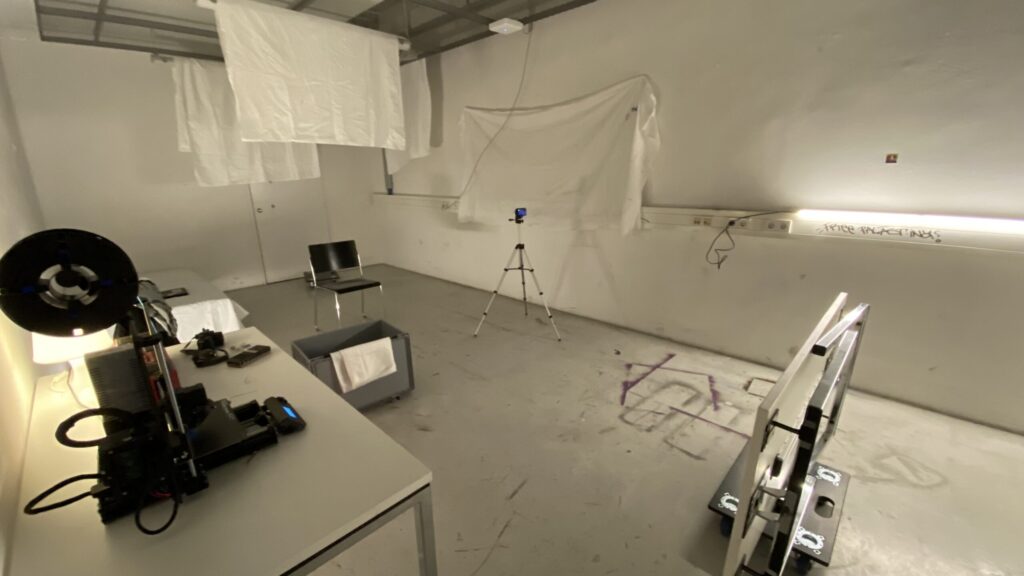
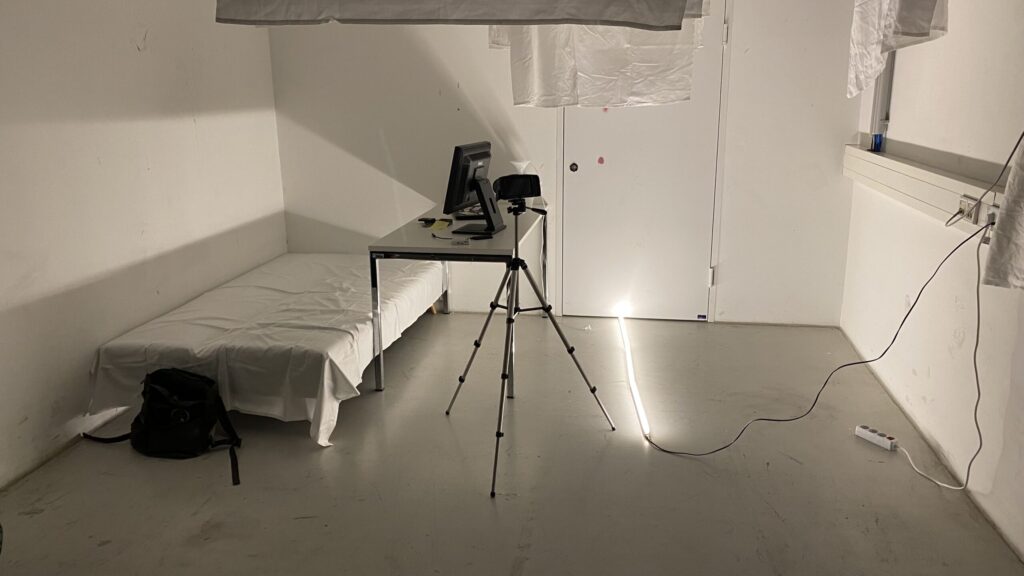
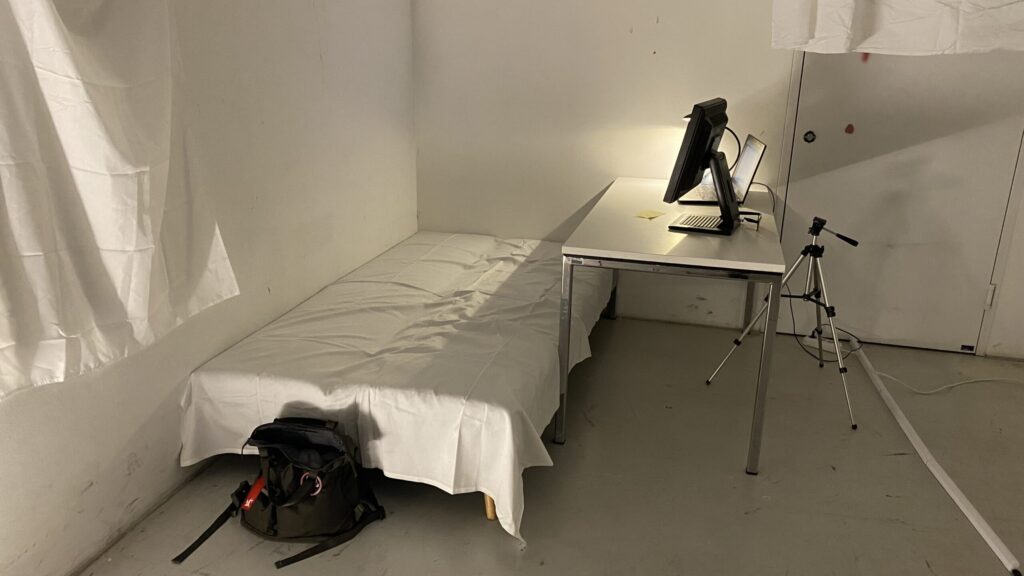
Reference material in “Tinklets of the Studio” blog.
Ylvie: Being given an opportunity to work with electronics is great, but the concept needs ways to persist in the visiting audience. Will they know where to get knowledge? Will they know how to continue after the workshop ends?
We are working on tests of this workshop
Parts Database for reproducibility like a kit
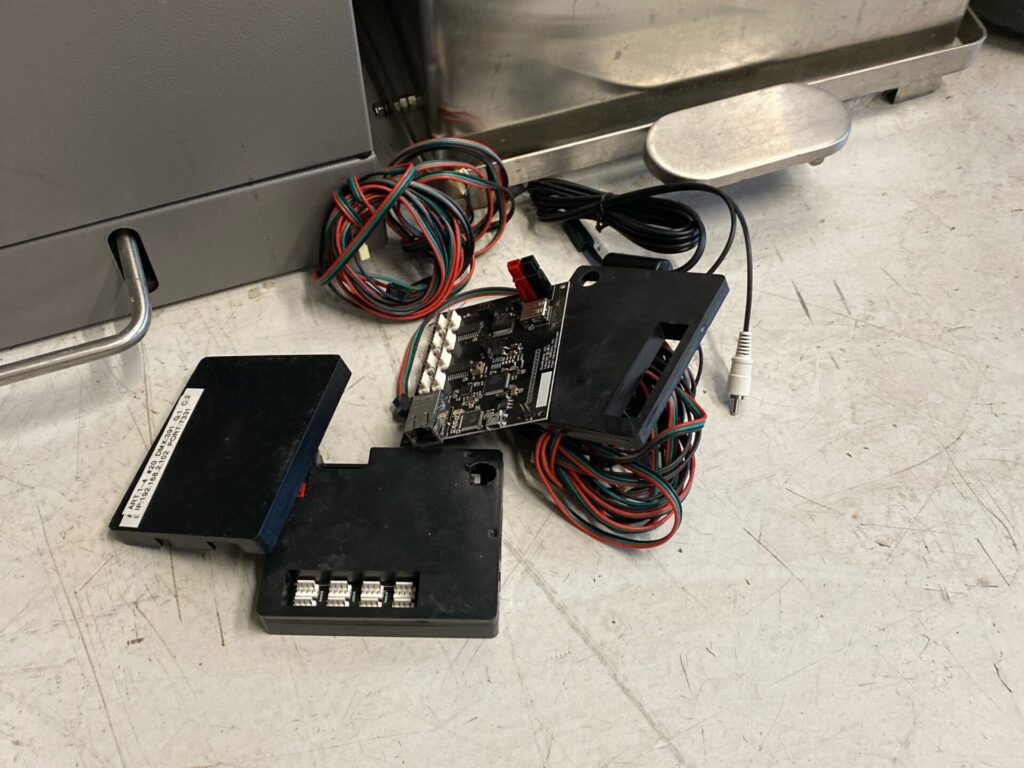
The accessible chips stand at odds with the complicated wiring of the underlying board
It started as small experiments with a lot of different Tinklets.
That is, small found electronics turned into new playful things.
I thought the final outcome would be something concrete and be embodied in a specific object.
But because what I want to show is so involved, it is turning into a more abstract framework of different aspects that I want to communicate.
I want to:
Make people interested in making something and learning the things needed to make it happen,
Make them able to recognize something in a mountain of junk, something someone threw away
Contribute to reduction of and awareness about electronics waste,
Make the movement/idea/project non-intimidating and accessible for others to engage in,
Core aspects:
Electronics, Right to Repair and recycling/upcycling
Playful attitude and learning new things
My personal experience/character
These aspects are intertwined. Together they constitute my body of work.
This is moving me away from making specific tinklets, into the direction of a coworking experimenting desk, where visitors can experiment with electronics, and experience my messaging and viewpoint.
At the same time, when facing an audience, the topic of electronics is too broad to offer. While conceptualizing with Ana, we focused on a manageable task the visitors can accomplish during their visit.
Next steps
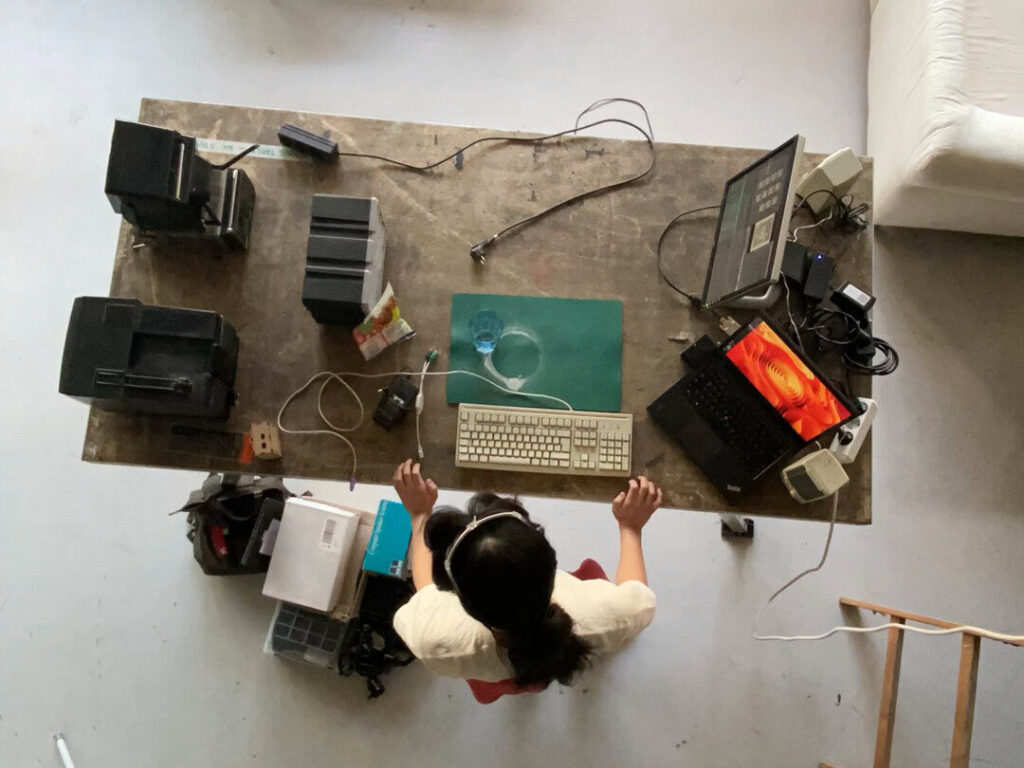
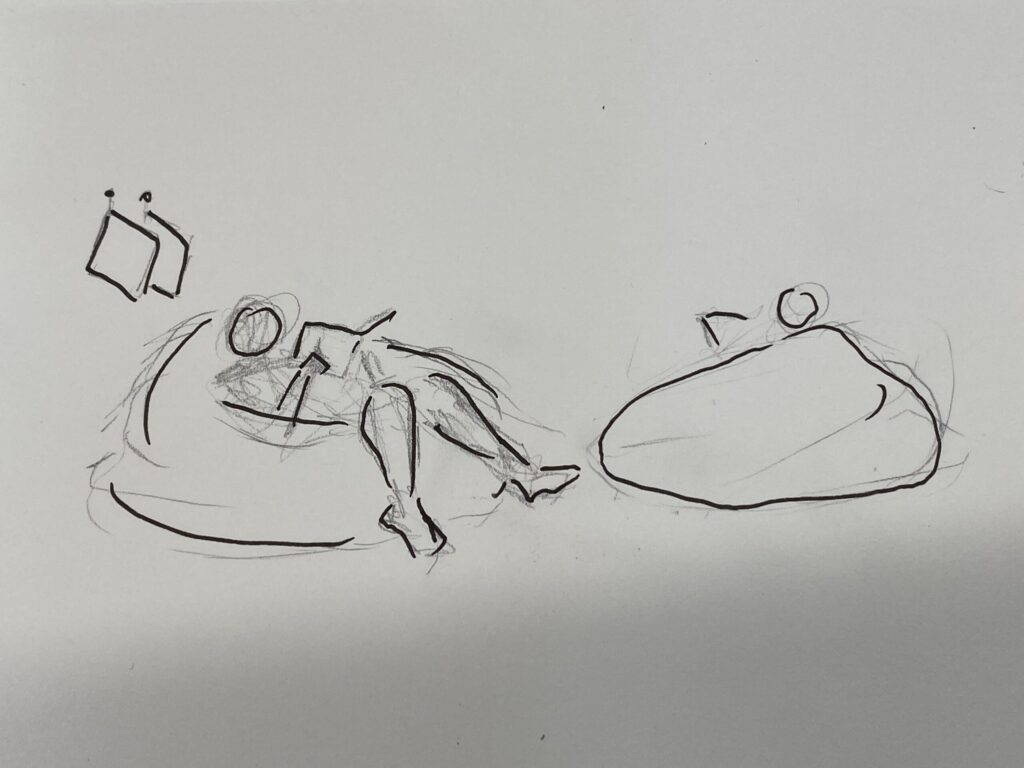
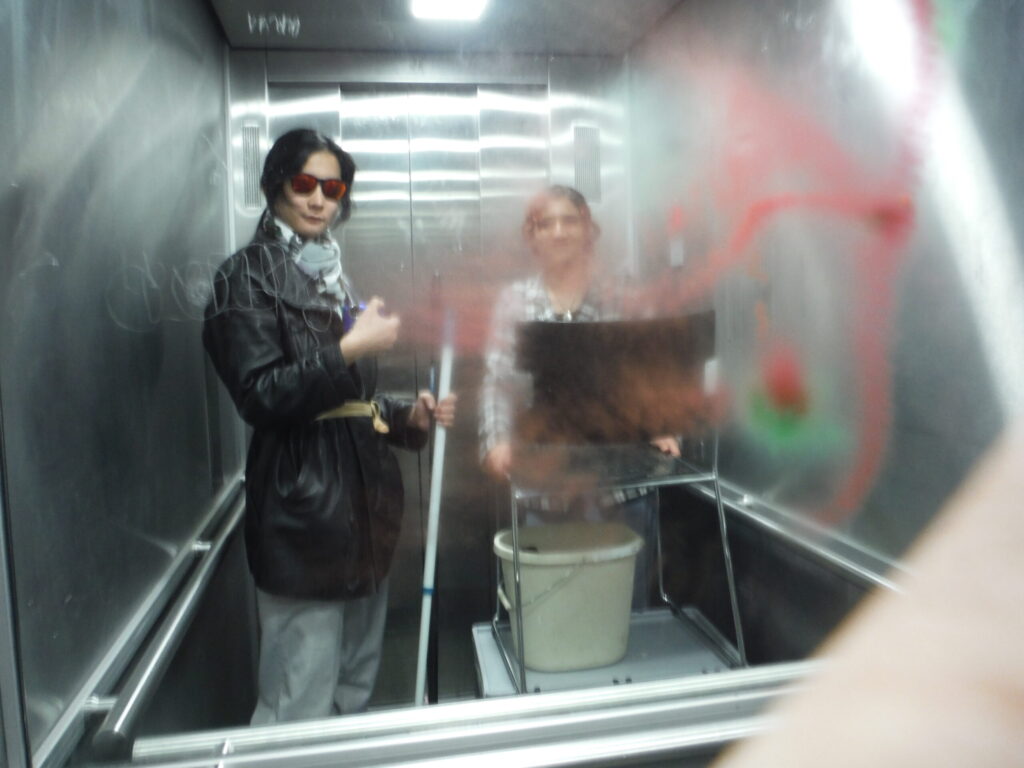
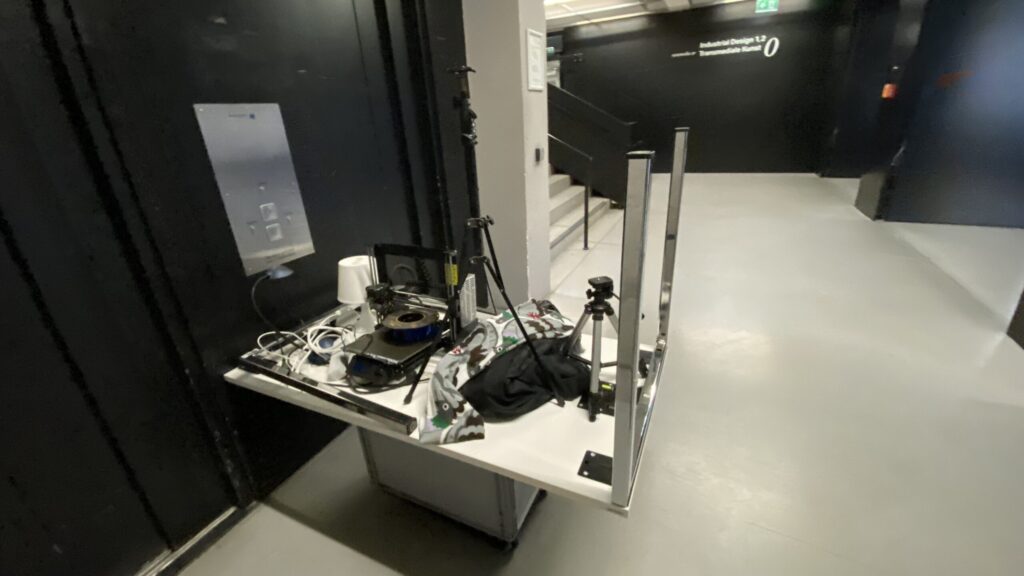
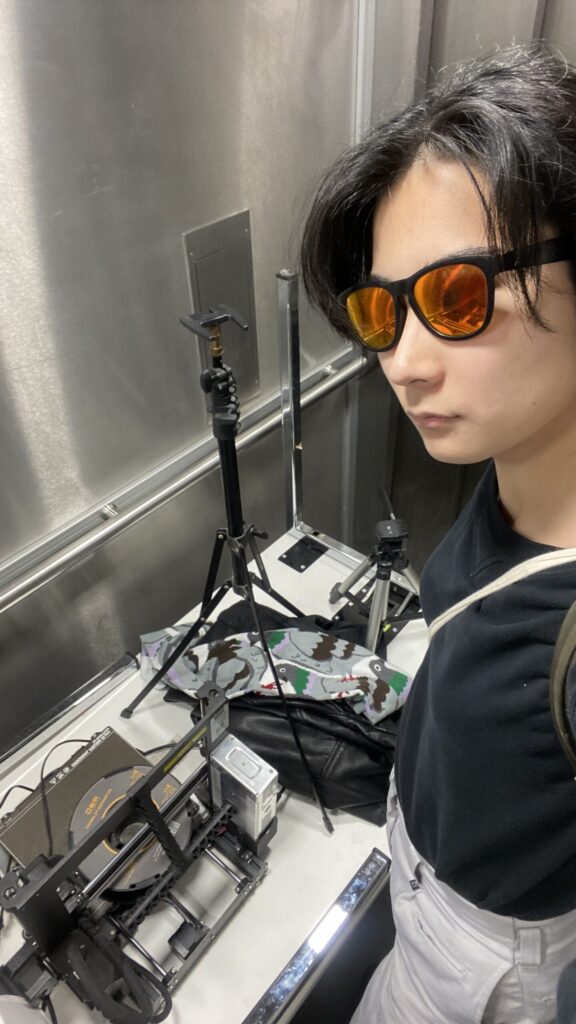
Trying various desk setups
Getting a feeling for the workshop flow
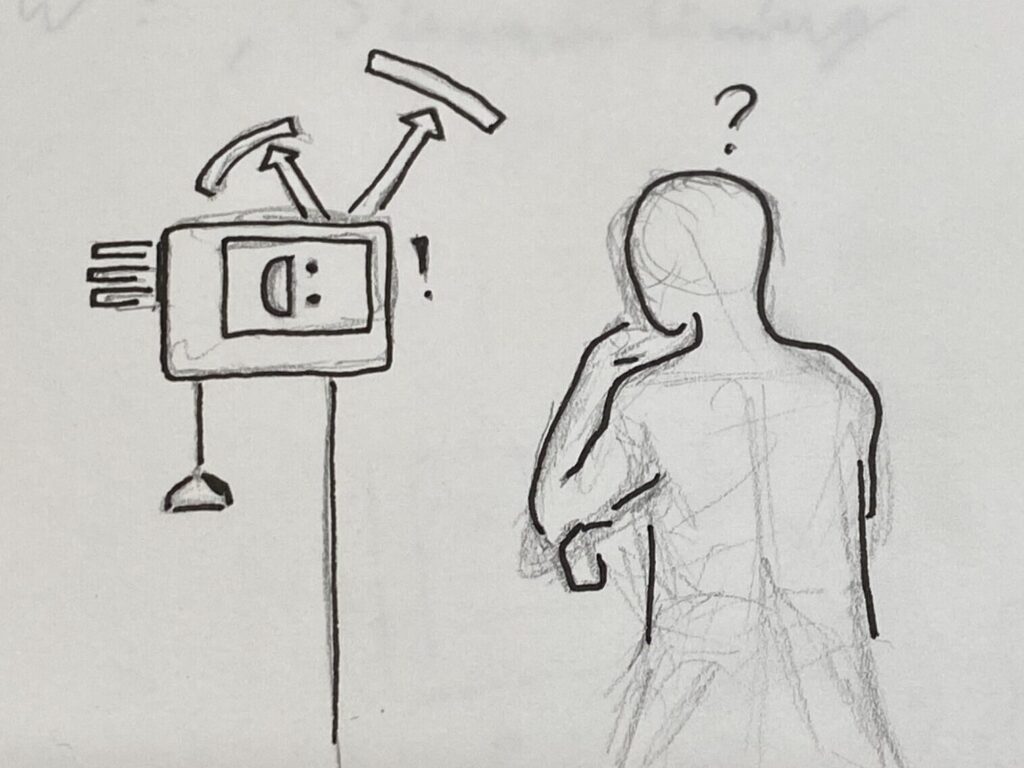
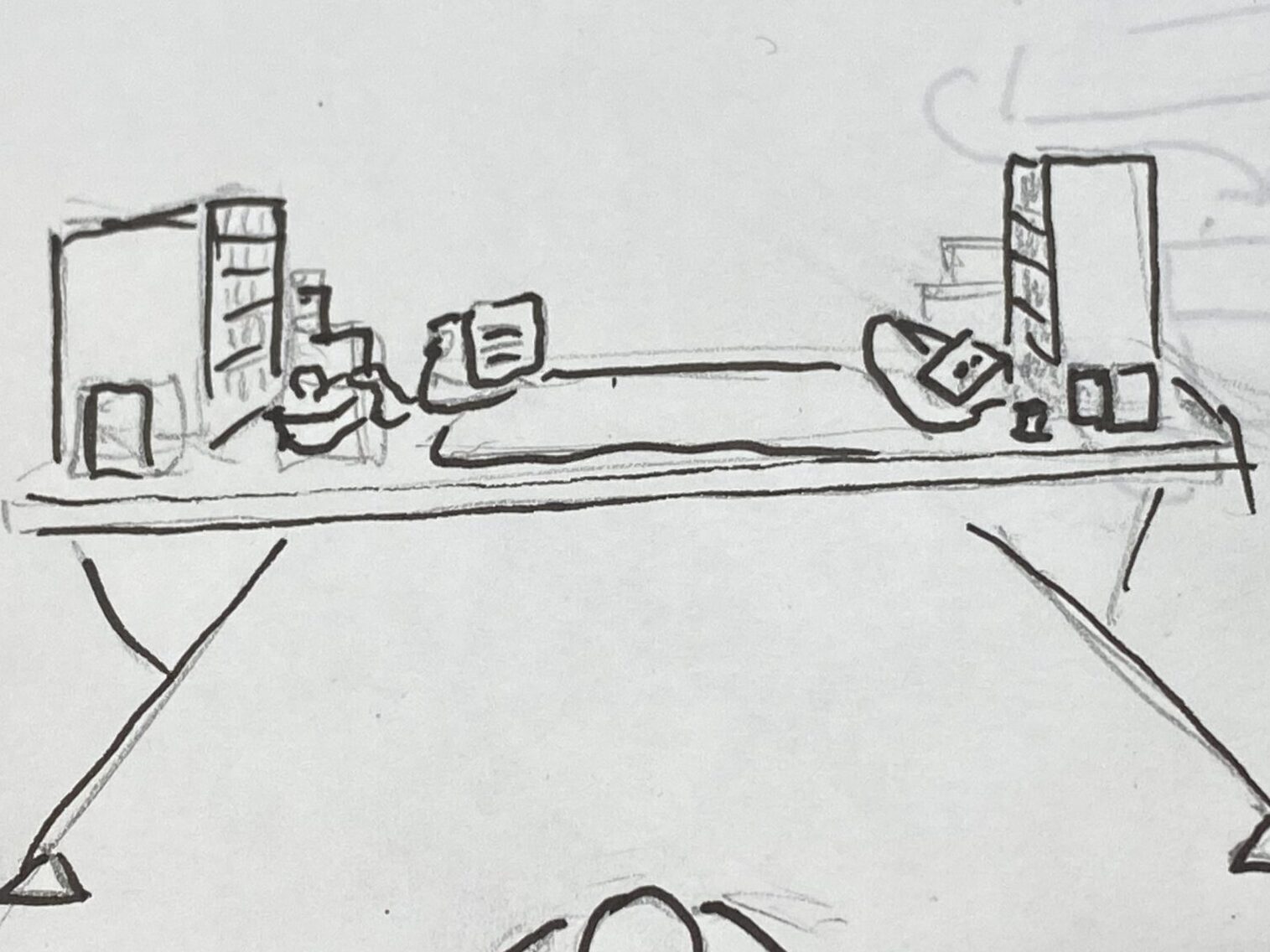
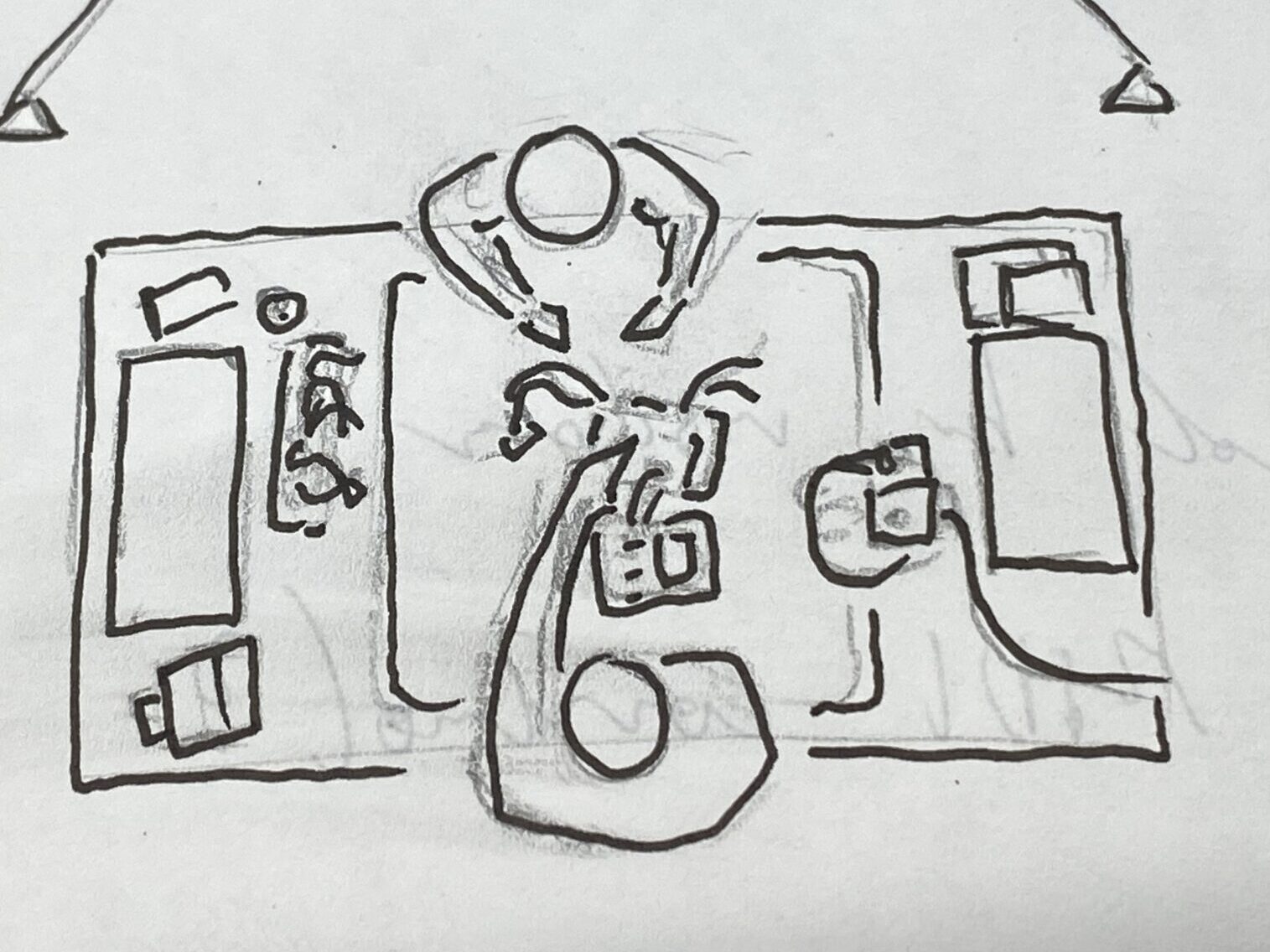
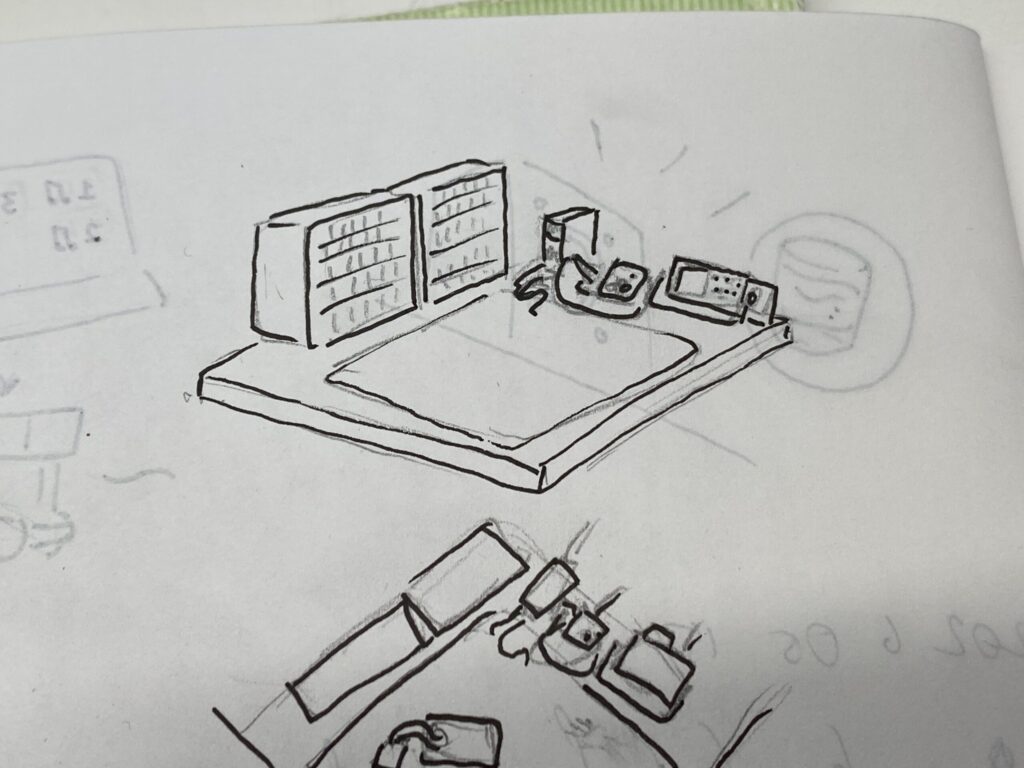
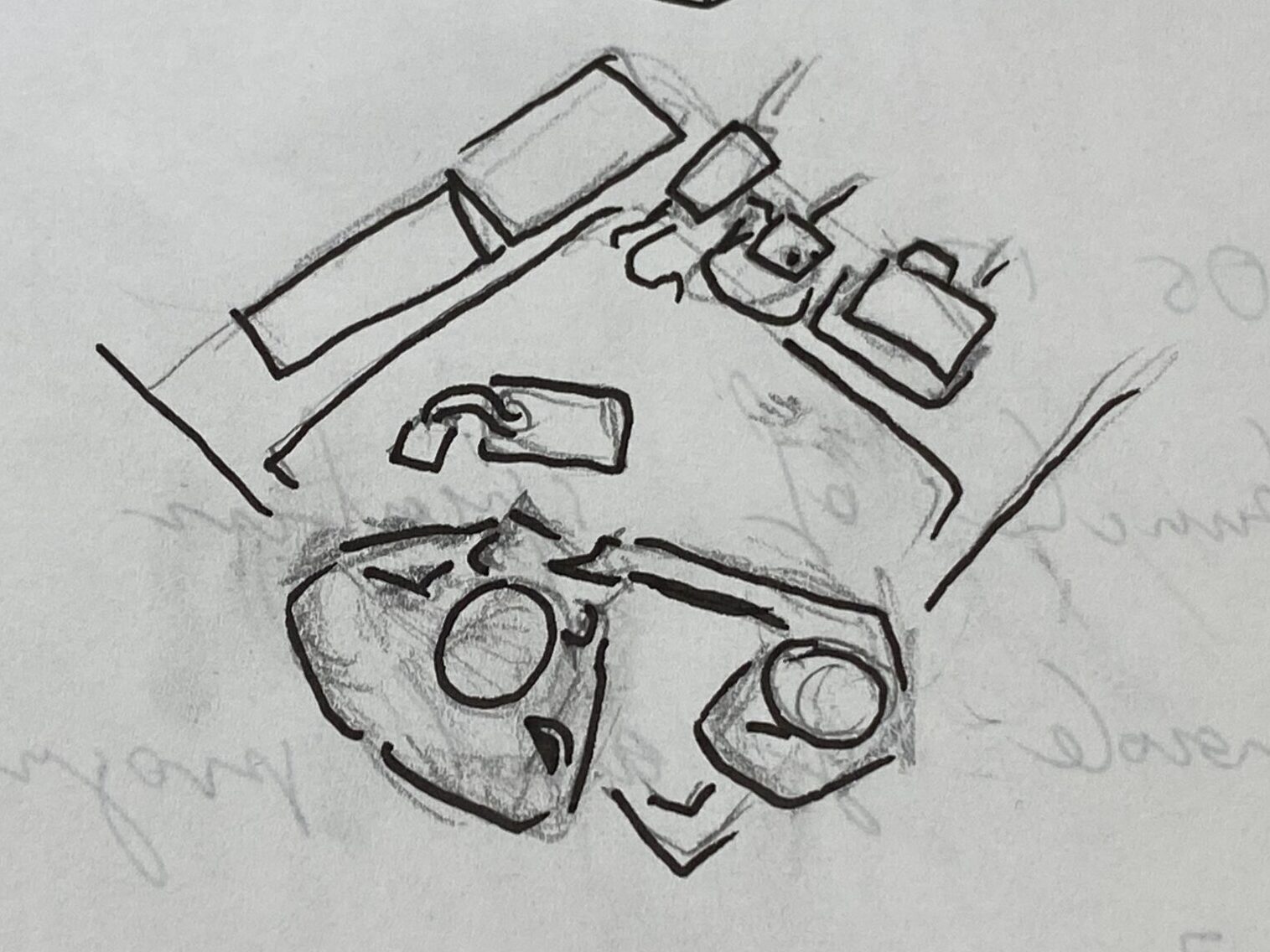
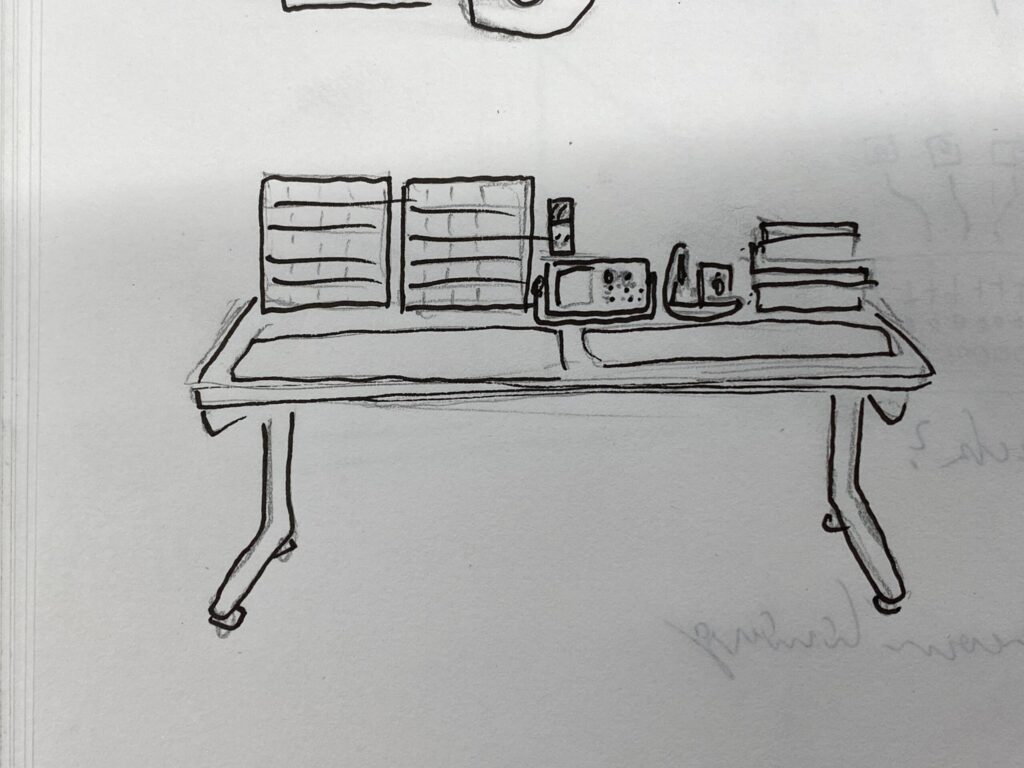
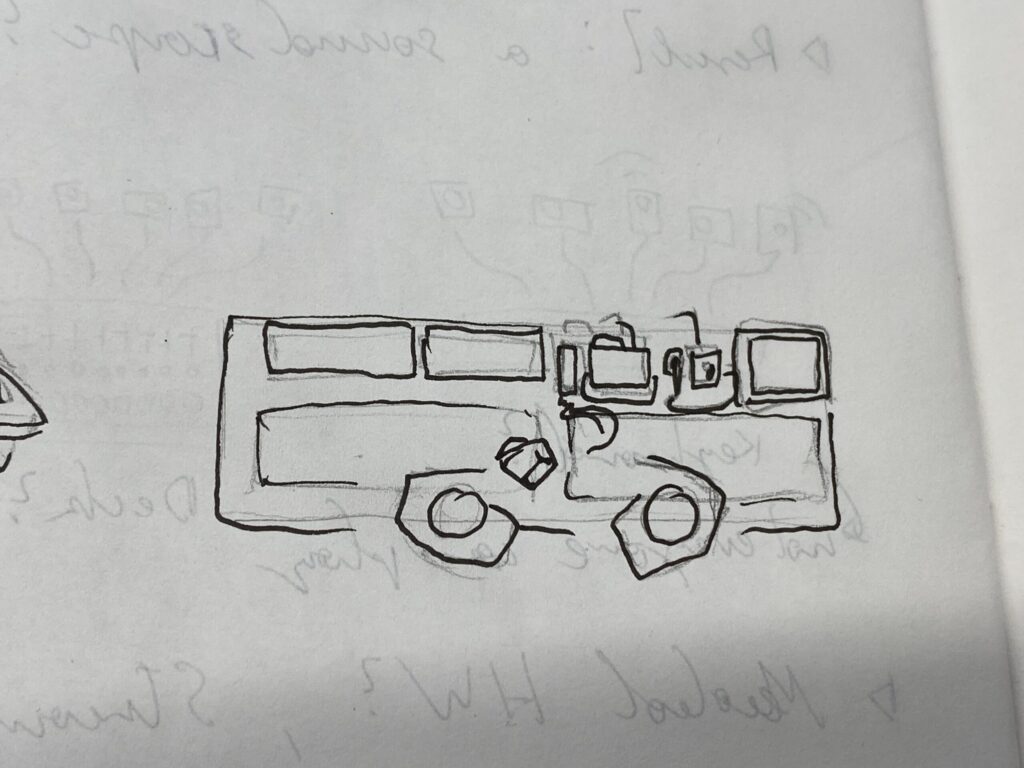
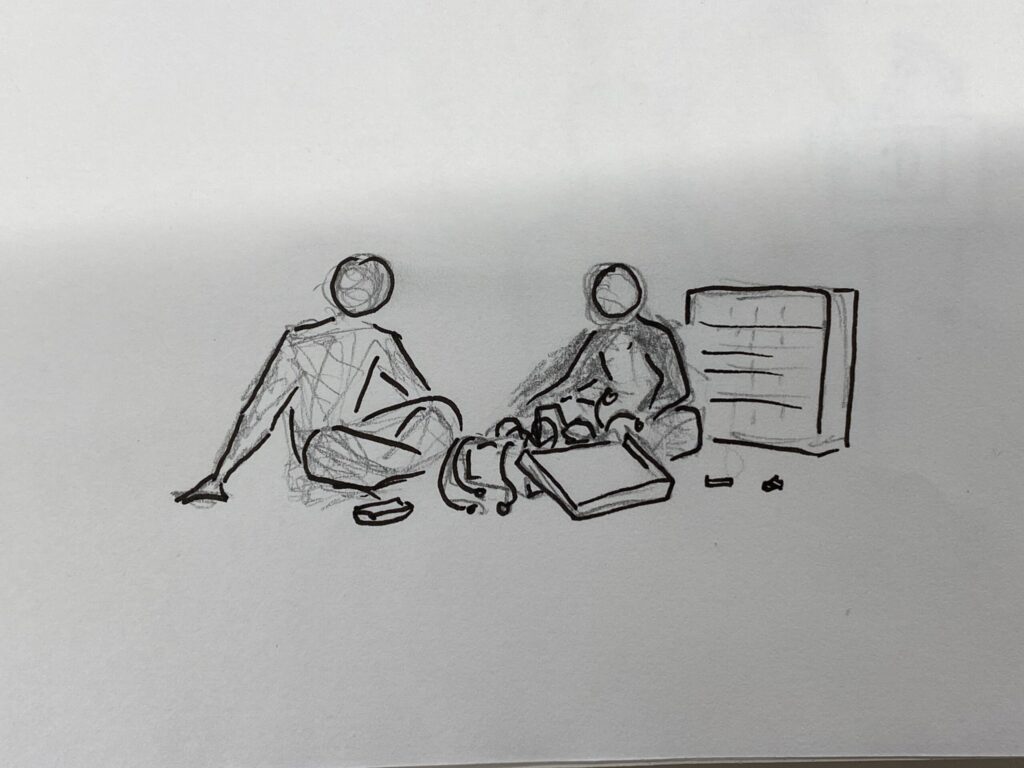
What could it look like?
[^visual reference]
"Moses-channel"-style desk.

Two participants, one a visitor, sit facing each other.
L-bend workspace.

Participants do not face each other.
Requires square table.
Wide bench.

Several participants sit side by side.
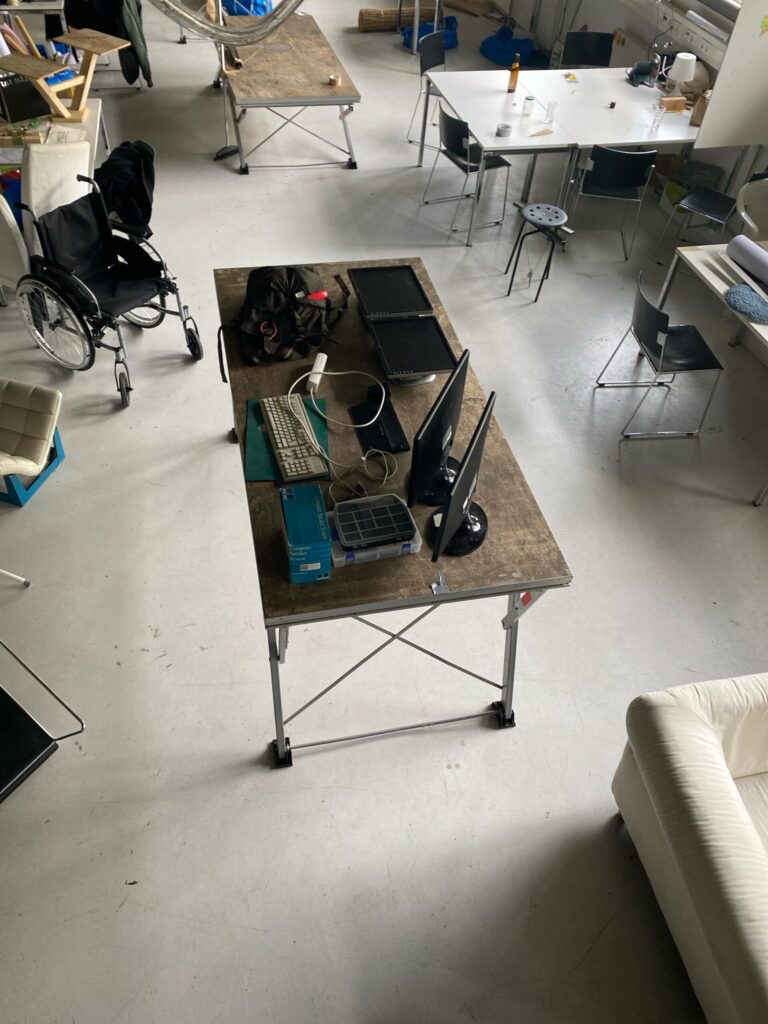
Already existing layout.
Working on the floor.

Association with playing with LEGOs on the floor.

Extra: Manuals and experiments reading corner.
After the Midterms, I had been floating, partly on post-stress stupor, but also around a fundamental question surrounding my project: What is it about? What holds it together?
Now when people ask me, I reply with the standard “Most people are intimidated by electronics and I want to bring it closer to people.” but this is a very broad answer, it doesn’t really answer the question “what are you working on?”.
Collab announcement: Ana Mikadze!
(Ana indtroduces their topic)
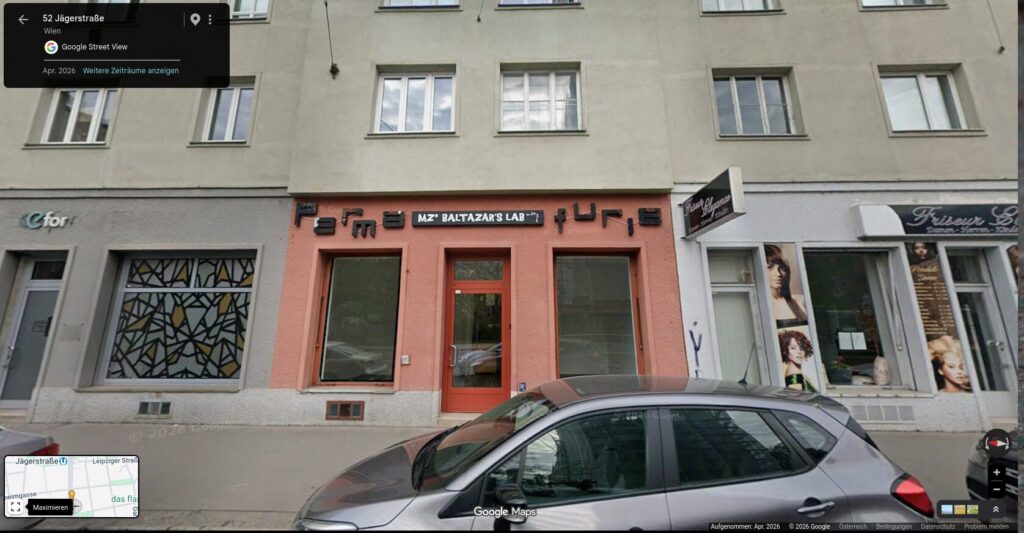
They approached me saying they know a place that would fit my interest and skillset.
The place is called Mz*Baltazar’s Lab.
The Lab is currently looking for more participants in their exhibition starting June 25th.
The project is now given a specific stage to work within, since the exhibition has restrictions on size etc.
Concept / Installation
The Tinkerer’s Desk
The Tinkerer’s Desk is an installation that takes the classic image of the lone genius at their workbench and quietly dismantles it.
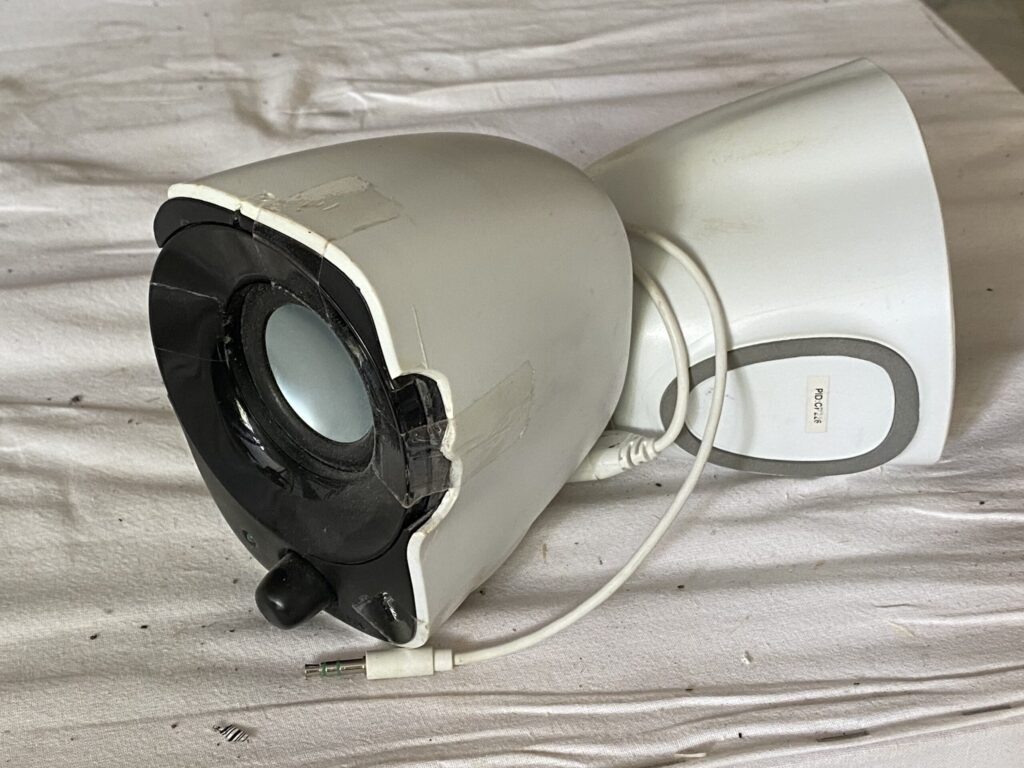
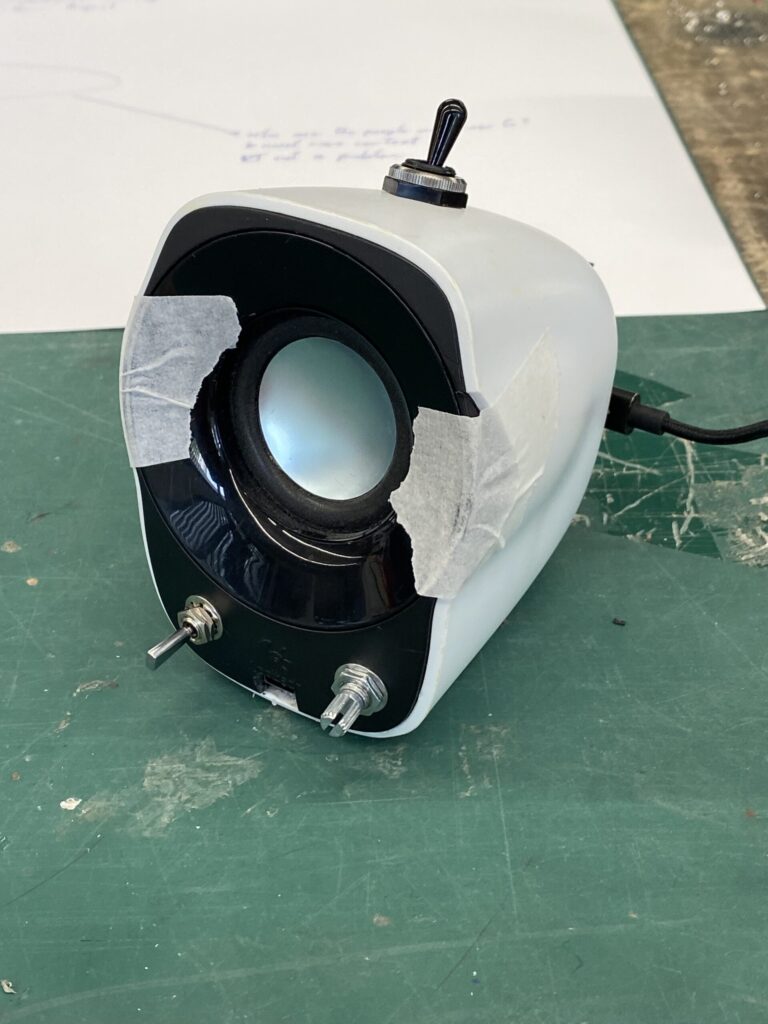
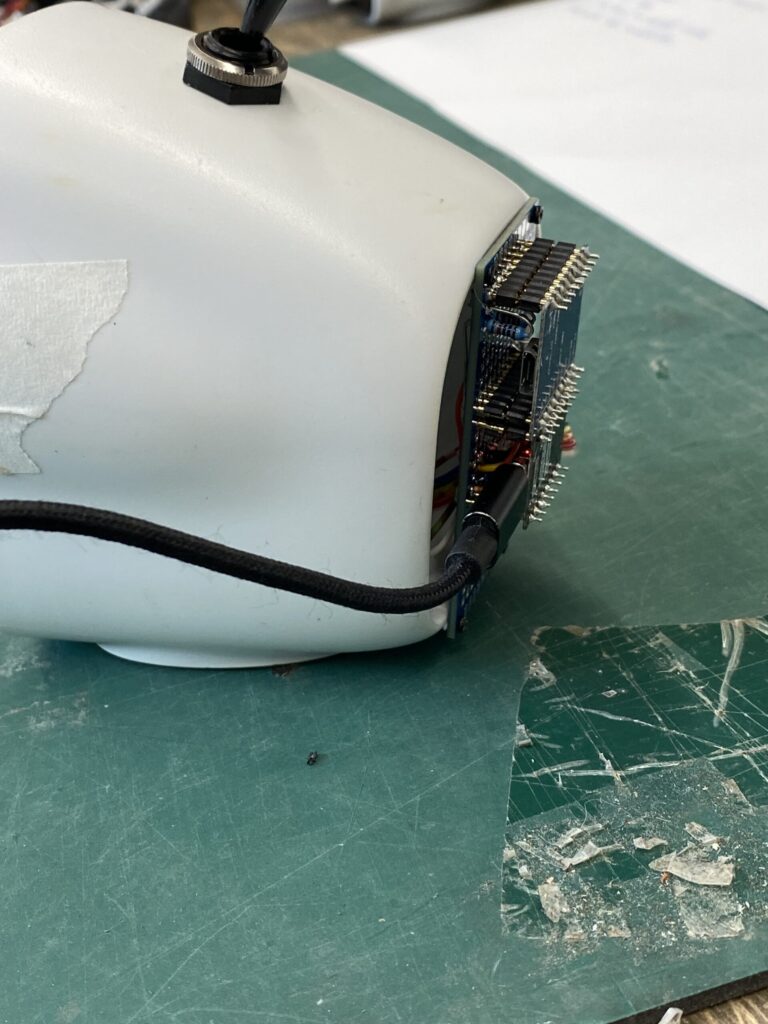
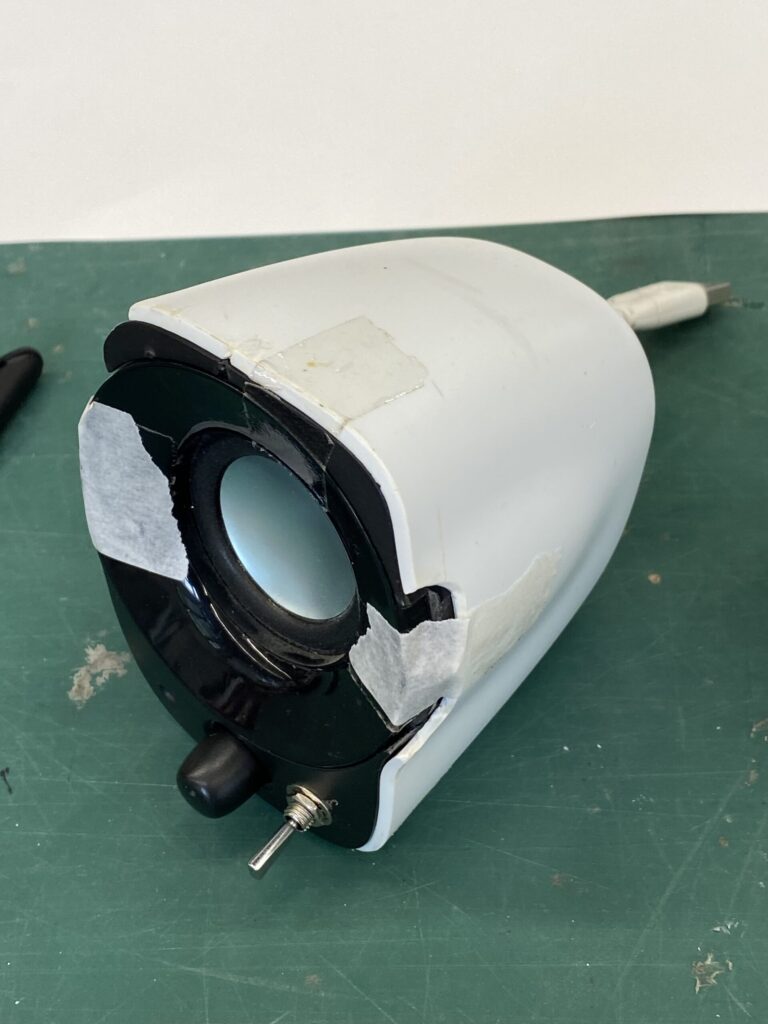
The desk presented here is designed for multiple bodies, multiple intentions, no hierarchy of skill. During a [three-hour] live activation, visitors are invited to record a six-second sound – a breath, a word, a tone or accidental noise and program it into a broken speaker, assembled and disassembled by hand on the spot. The broken speaker is not repaired so much as redirected: imperfection is retained as character. The speakers produced across the activation accumulate into a site-specific polyphonic instrument — a spontaneous archive of a particular space, a particular group of people, a particular slice of time. Each speaker holds one voice. Together, they can be played: triggered individually or in combination, they produce a sound environment that belongs to no single author and no fixed composition.
What results is less a concert than a conversation between objects, a collective memory that remains activatable – catchable — long after the workshop has ended.
I was talking with Clark about how I was going in circles and he suggested doing live streams, or filming myself doing the projects. This way makes it easier for me to document my progress. I was hesitant to do it until now due to limited storage or bad memory workflow, but I have to overcome this obstacle.
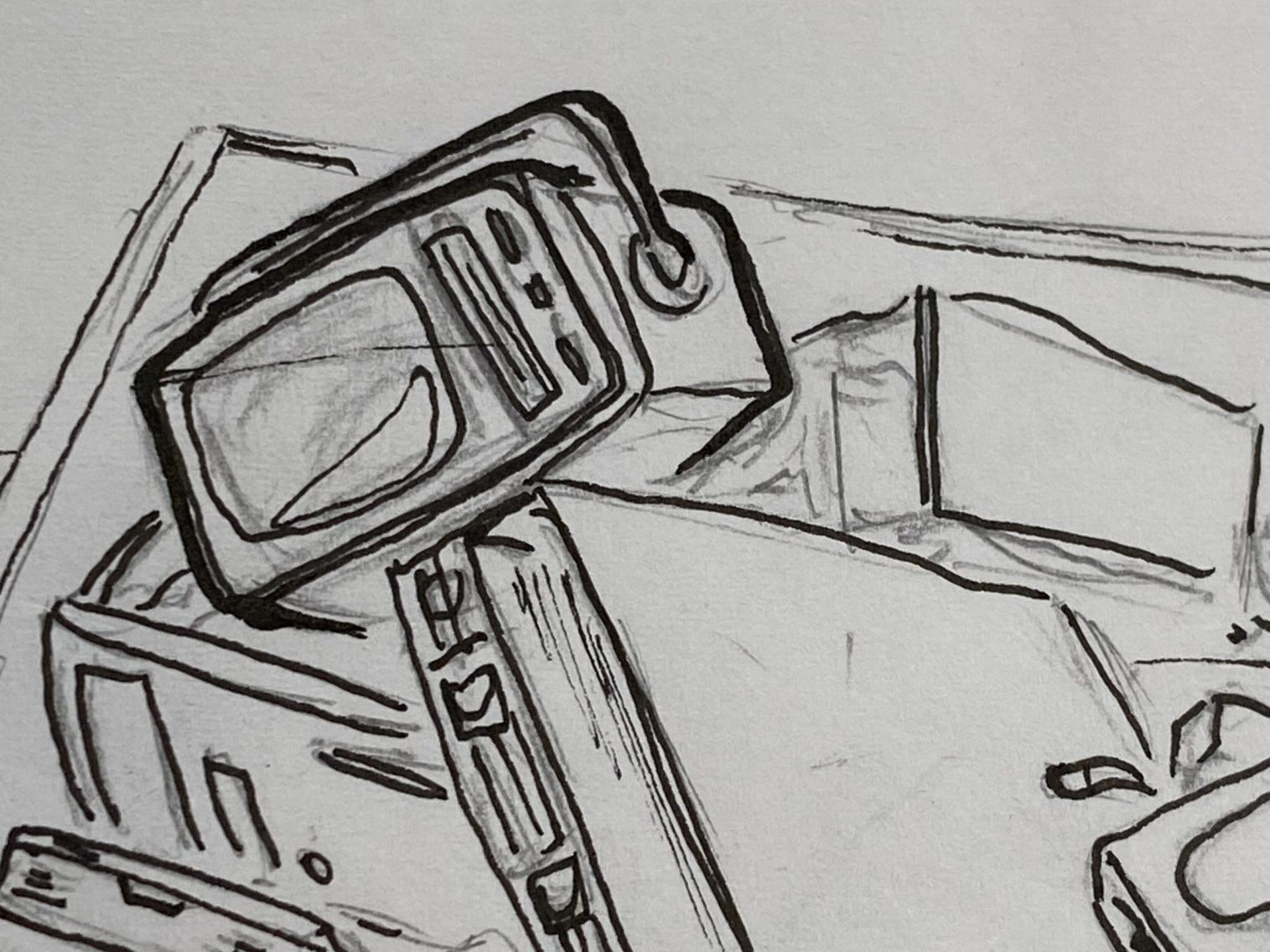
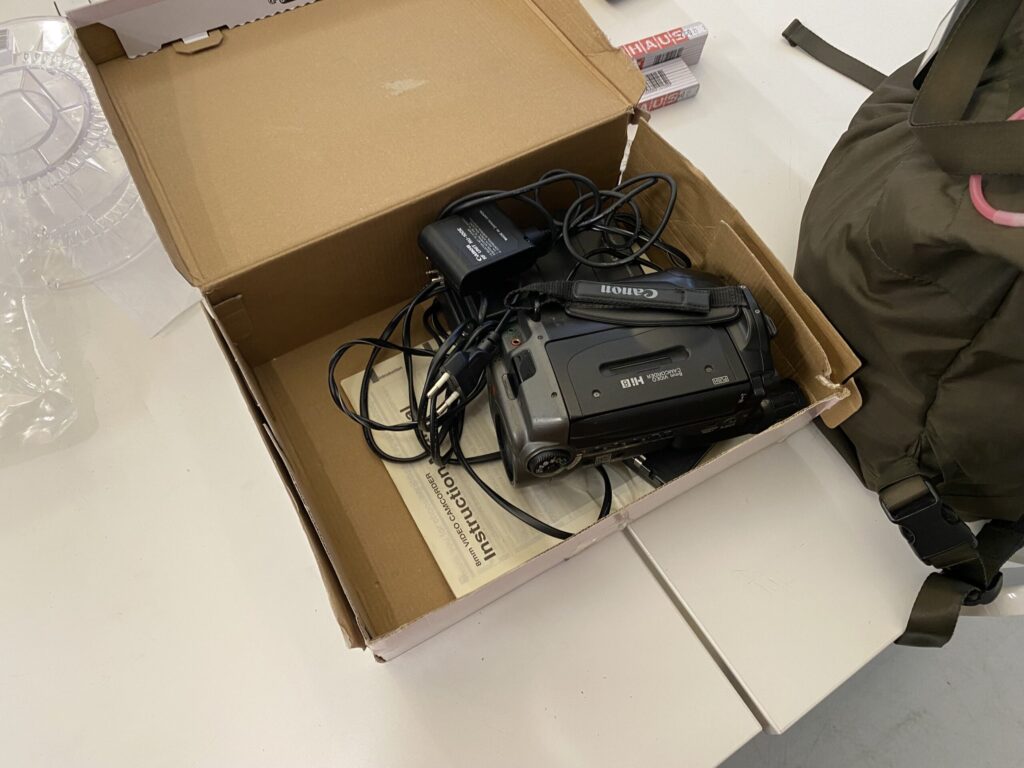
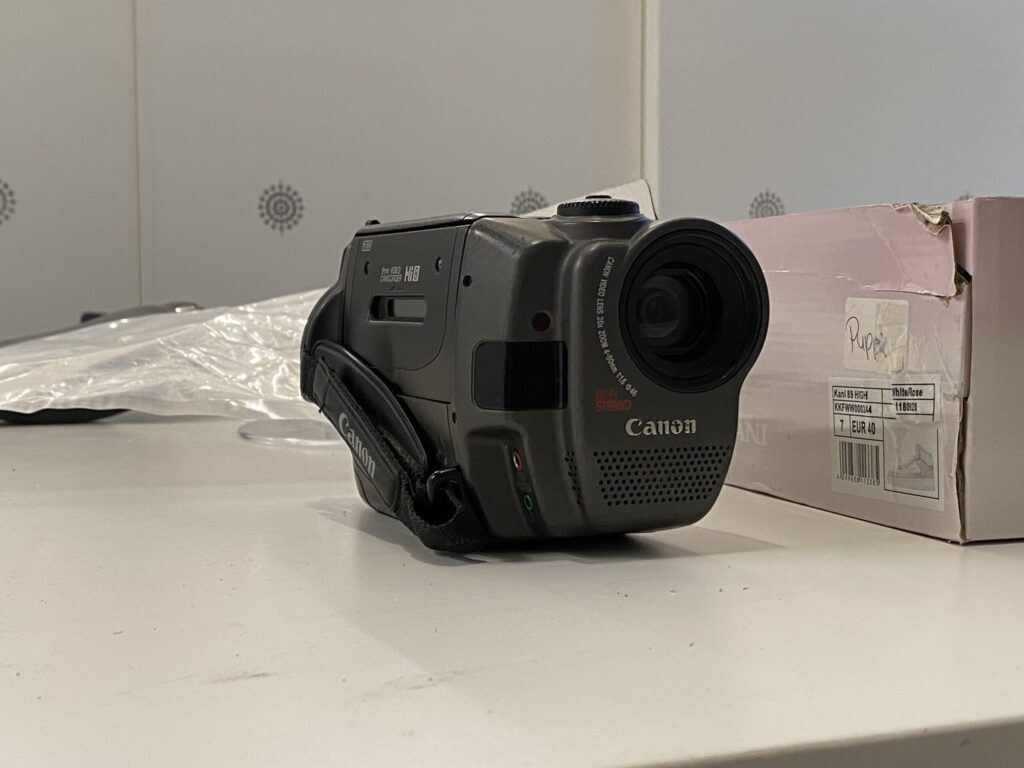
Camera I bought in the hopes of filming myself
Philip reminded me of the products of Mark Rober, among them the HackPack, a subscription of packages with different projects aimed at deepening understanding of key electronic principles. I should have looked at it much earlier, since it is a relevant topic to my project…
Since the HackPack goes into a different direction he suggested I could design a starter pack or similar more going in the direction of modifying and fixing electronics.
Nadine is interested in being able to ask questions about the things that can be hacked. While doing so she finds being able to interact physically is important. She suggests an environment of group events. About hacking, fixing, whatever comes to mind.
When people ask me what my project is about, I mostly answer that it has to do with electronics and how I want to bring people closer to understanding them so they can fix/modify it themselves. There is potential for a community aspect but I have been struggling to fit it all into one framework.
The general idea is to have some installation that I can exhibit that shows off what is possible with tinkering, but also doesn’t intimidate with complexity.
Next steps:
Should I pivot?
Should I kill some darlings so I can get something done?
Are there things I should consider more?
Are there things I should worry less about?
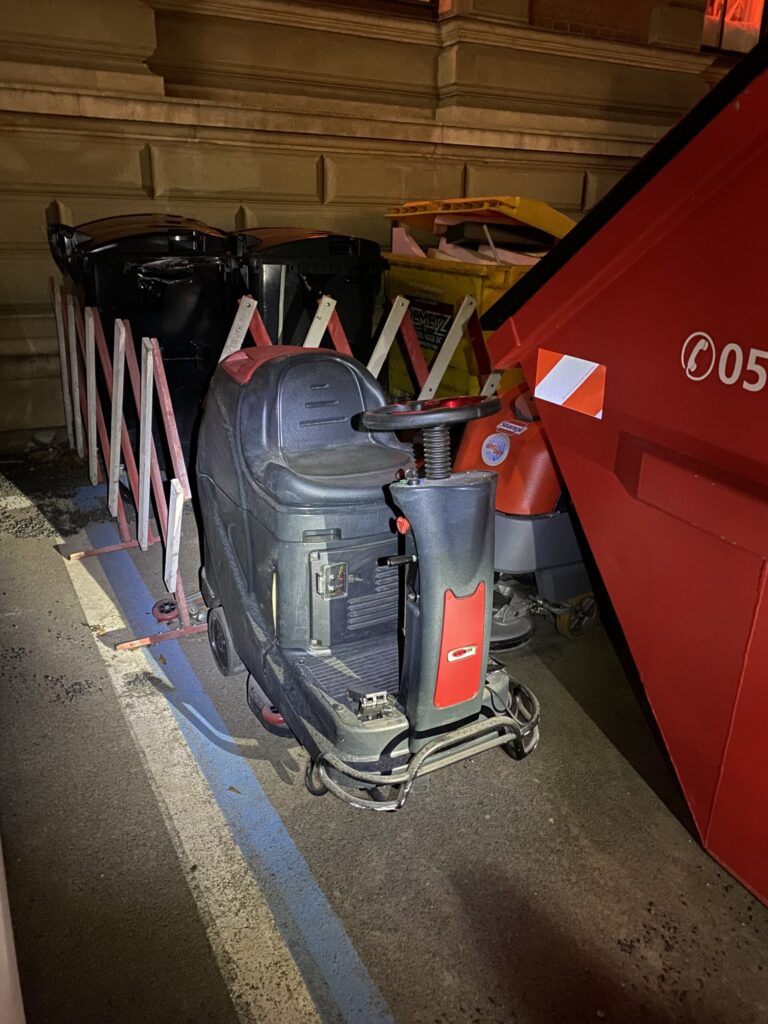
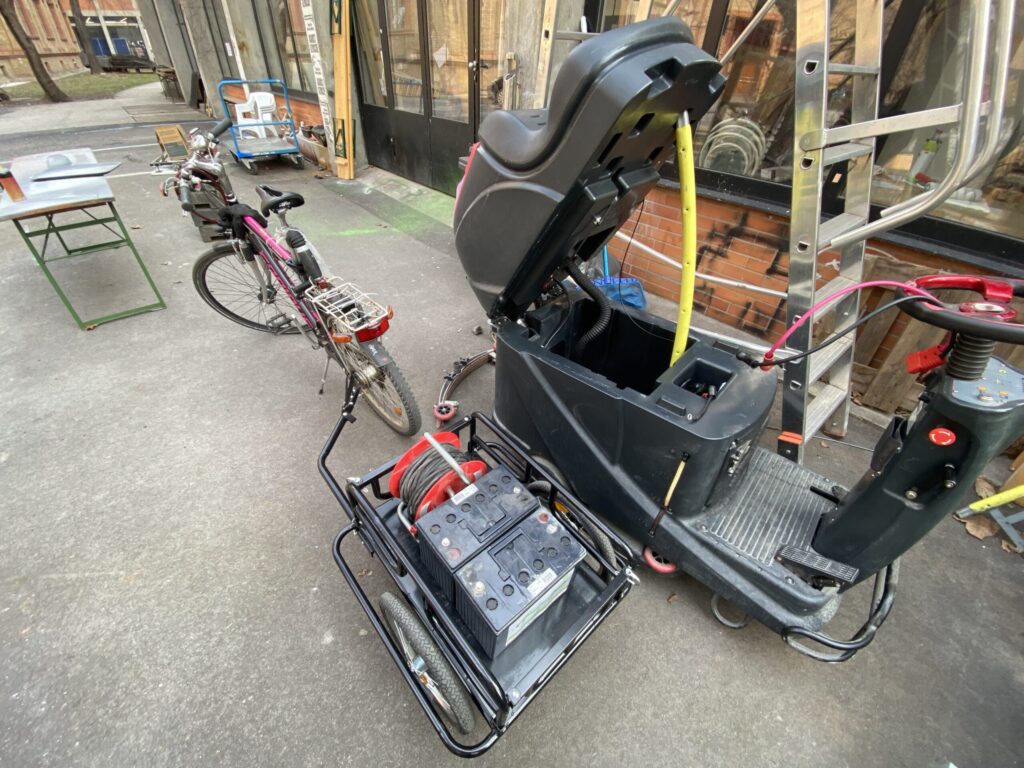
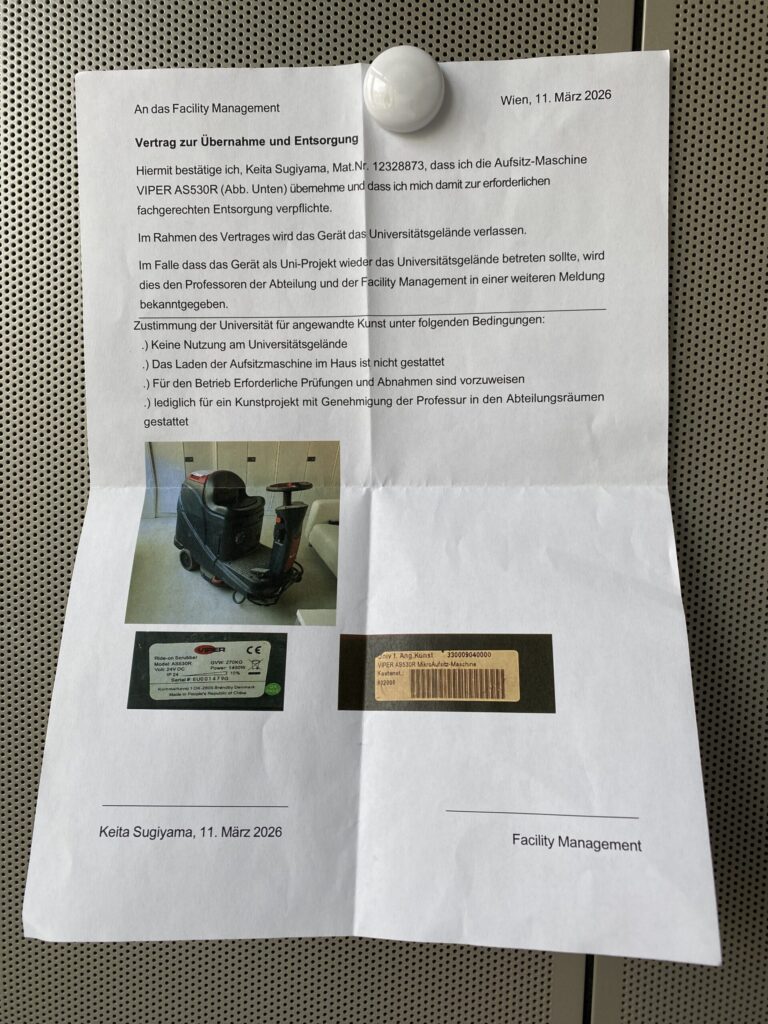
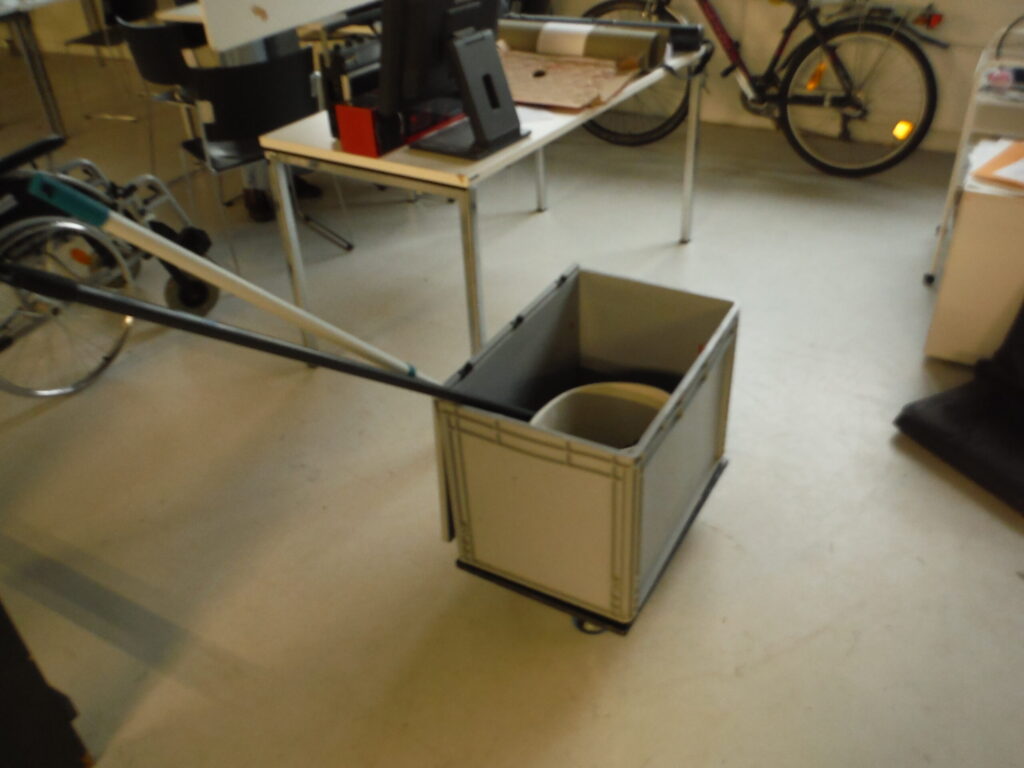
About the floor cleaner: I don’t want to miss recording important events, how should I go forward?
Personalized advertisements/infotainment displays in the studio…
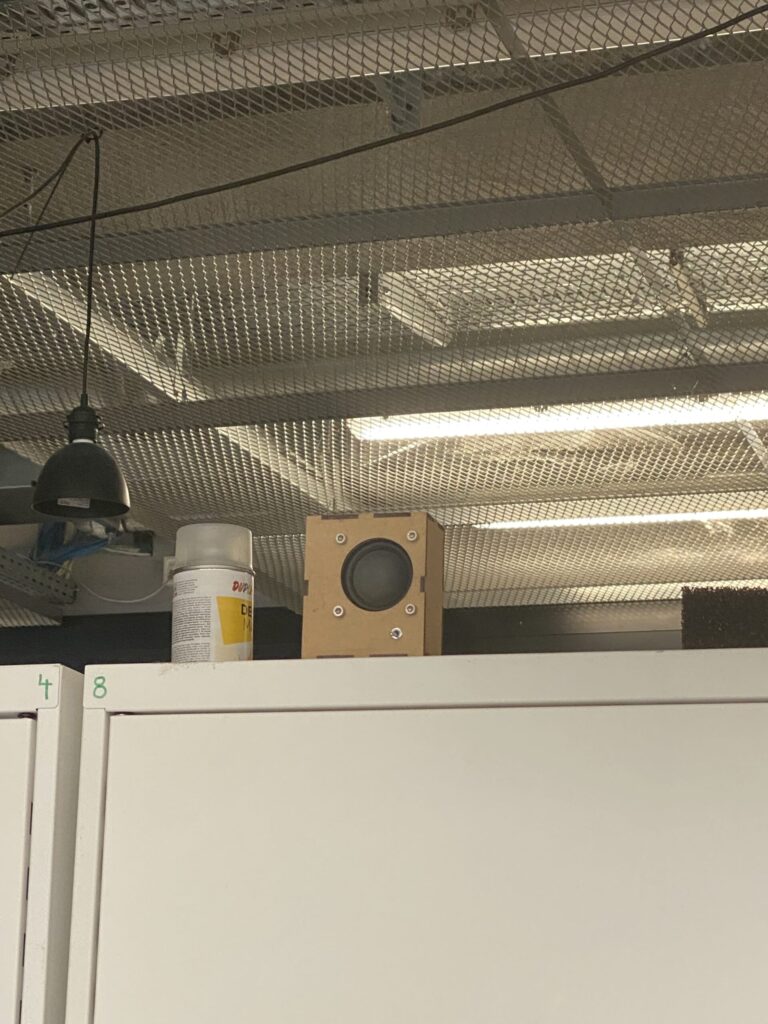
PA system in the studio…
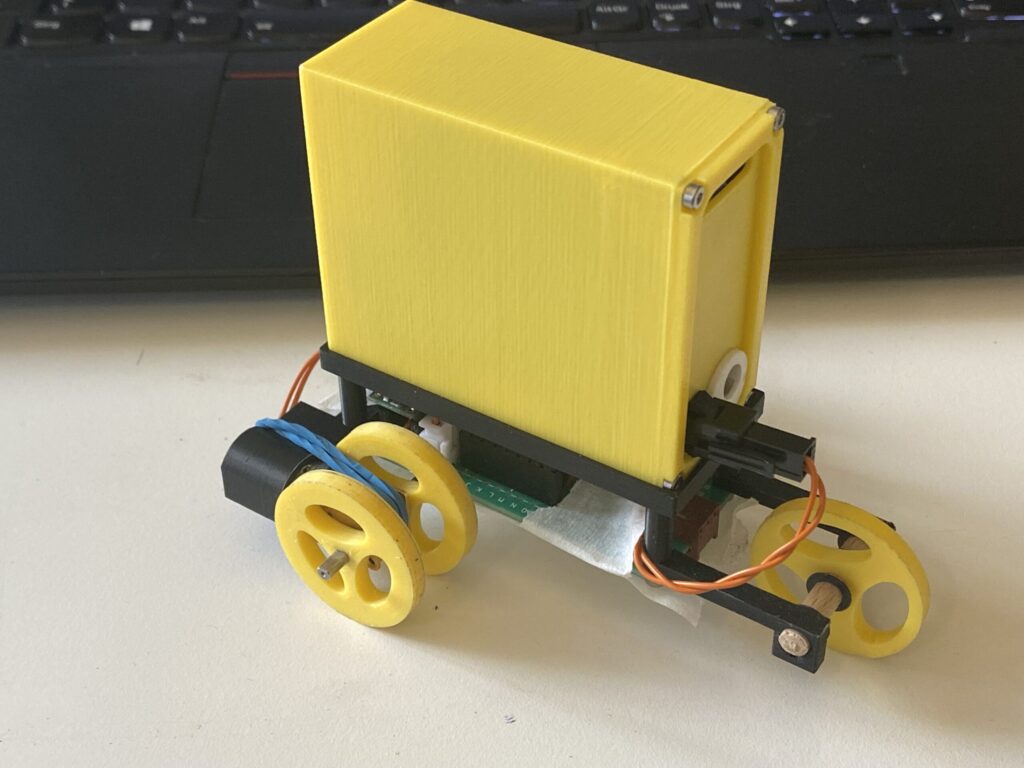
A little car going around reminding people of things…
Interactive e-ink display
Extremely small agentic AI in a box
Newcomb’s Problem experiment
The overarching theme is always the same: Create an intervention aimed at the students in the Studio (I am also including ID1 students for simplicity, because we are close by).
The question behind it should encompass the aspects of DIY-mentality/the determination of being able to do things yourself, the rejection of corporate controlled life, and cultivating a community which builds upon these values.
A potential question at this stage may be: “How can I cultivate a community of tinkerers?”
This question however implies that I am the central figure in leading such a community, which is not what I want.
Based on that the question could be modified into: “What supports the cultivation of a tinkerer community?” maybe “What does the tinkering community need to thrive?” or “What can we do to make tinkering more mainstream?”
I have done a lot of different things over the holidays, but felt like I was going in circles.
What happens is that I pour time into projects, but these projects are so complex and involved from the outside perspective that it is really hard to engage for strangers. I end up doing things in my corner.
Clark has suggested that I do livestreams, that is, record myself working on the project, so I dont have trouble trying to formulate my progress into text and having to remember what it is what I did on what day.
This can also mean an live audience who can engage with whatever it is that I’m doing.
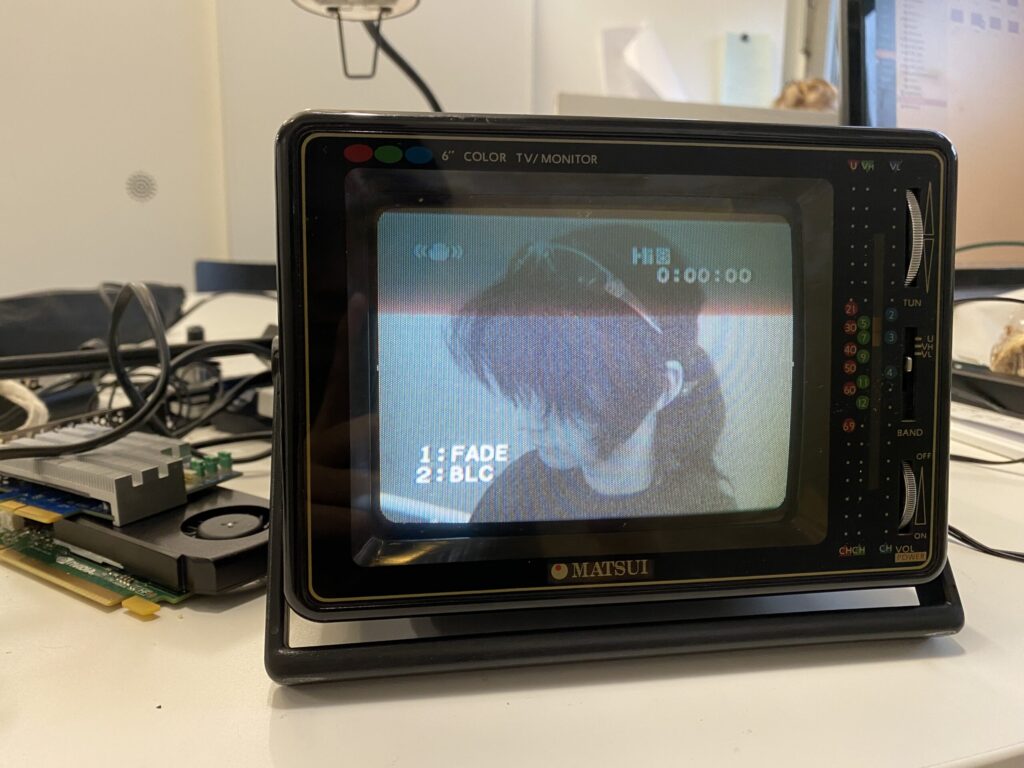
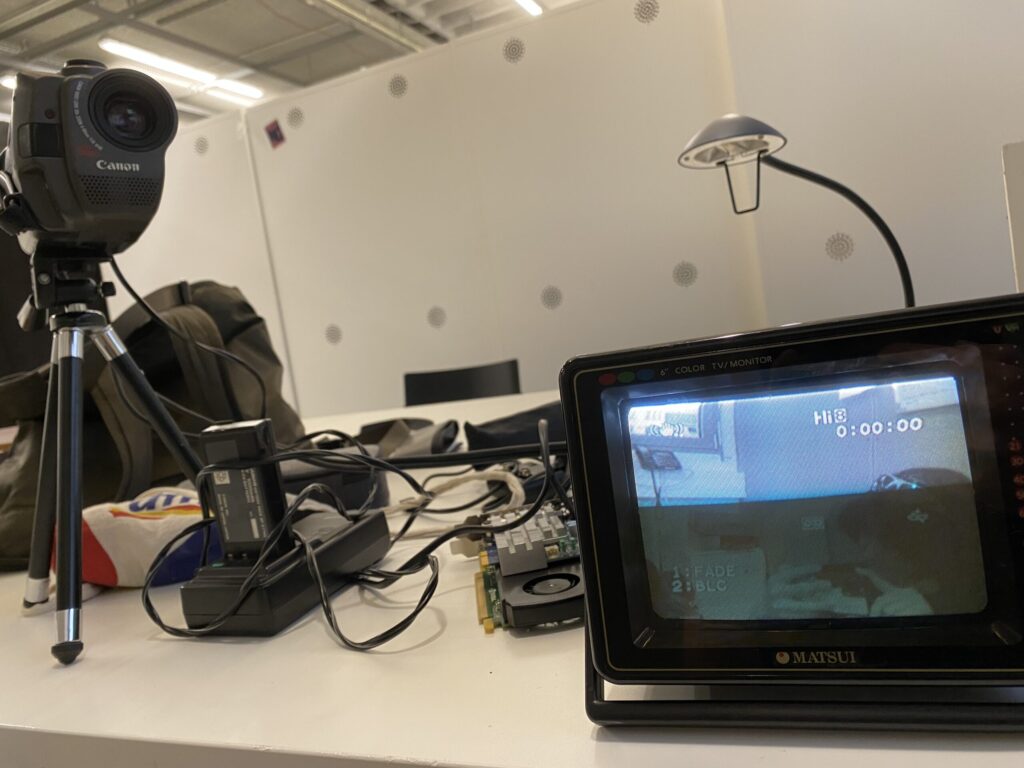
Self filming experiment:
The finished thing.
Filming myself indeed helped to document it a lot better than trying to take lots of pictures and explaining in text later.
Feedback from presentation techniques presentation run on 2026 06 03:
The passion from personal interest is visible and adds strength to the statements. But:
There is a crucial link missing from inspiration as a person to task as a designer to bring people closer to electronics.
The Tinklets are a nice intervention, but it lacks context and instructions for casual passerbys to really engage with the subject of the Tinklet. – Ylvie
About the workshop format: It is a really cool idea, and already really inspiring, but it needs a little more connection to more attachment points the participants can hook onto, otherwise this knowlege and experience floats in a vaccum.
My task as a designer (yes i’m a designer oh god)
Design a thing that once the workshop is over, is still in tangible reach of the participants. That includes further info or a beginner toolkit they can take home, aside from the speaker itself, optimally.
Design a process through which the participants can engage, understand, and gain context to be able to independently continue tinkering.
Understand what keeps people away (or doesn’t) from engaging more critically with electronics.
How do I sell the coolness of repairing electronics?
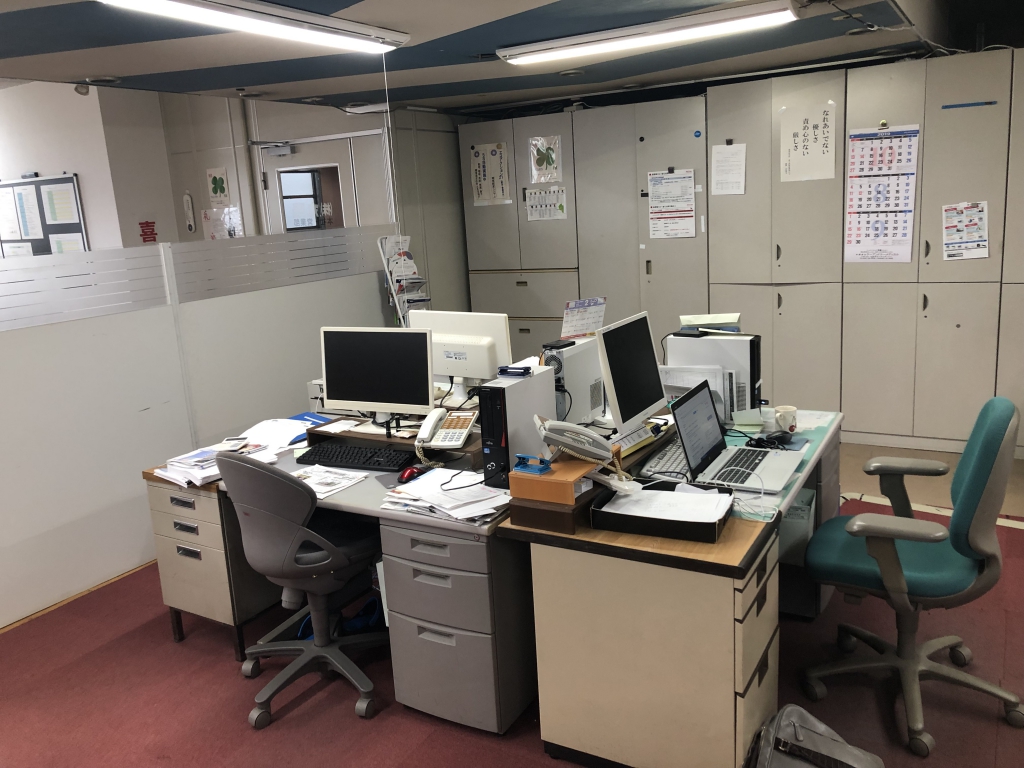
As a product of the tertiary economy sector, offices encompass and lay claim to a tangible amount of resources: demand raw materials, use logistics, use infrastructure, occupy buildings.
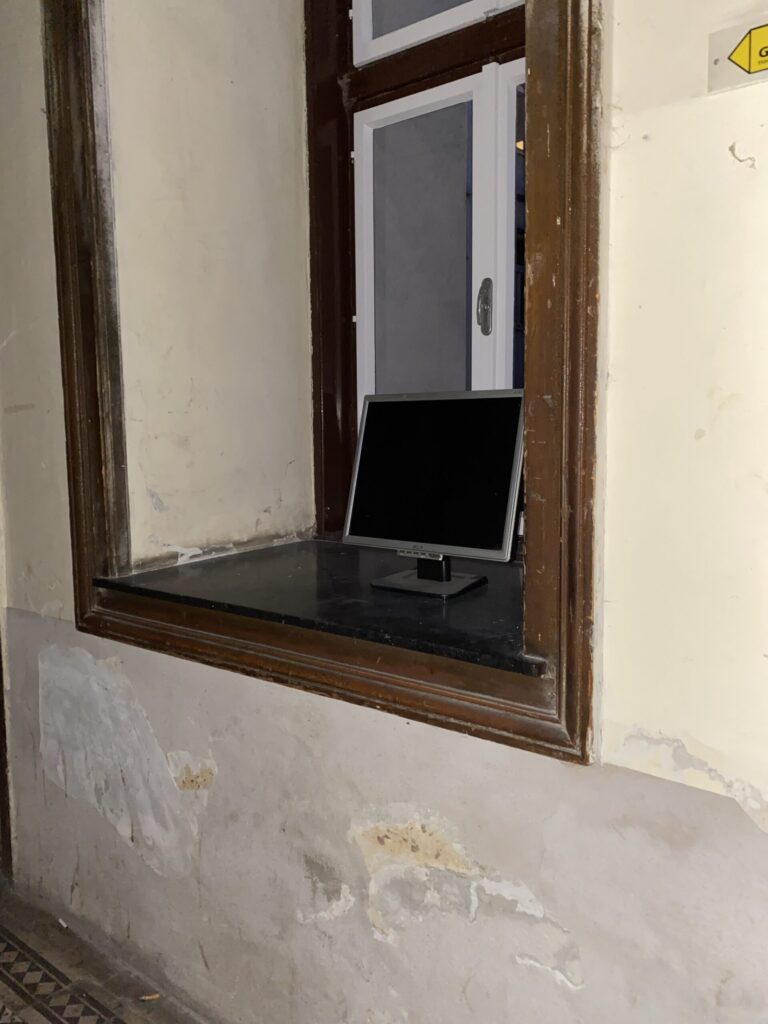
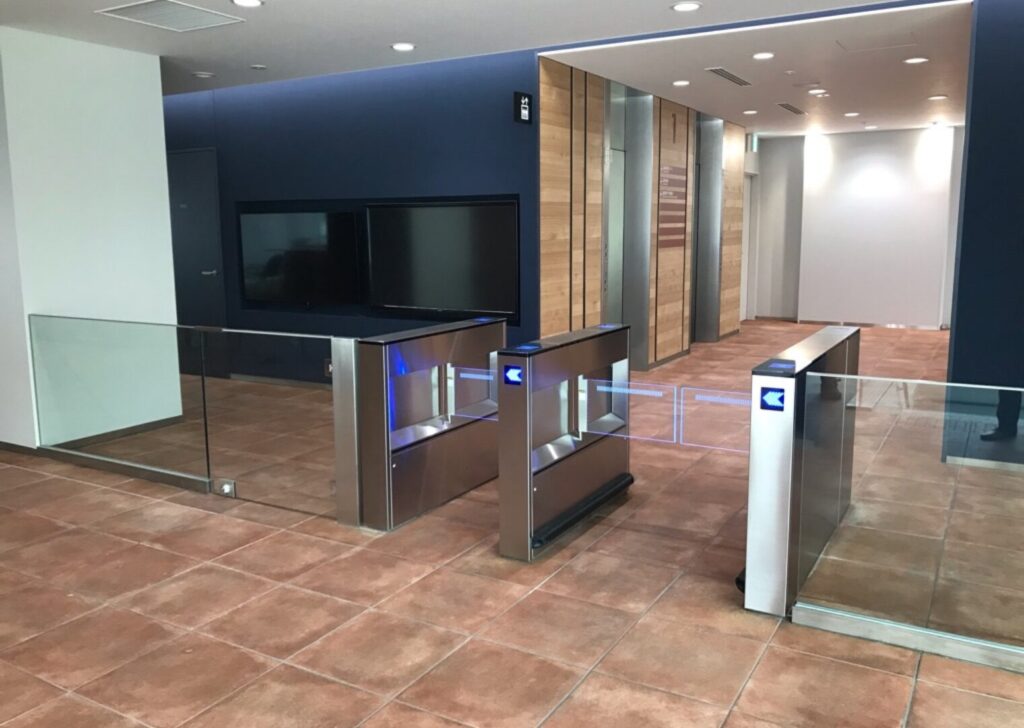
Typical office entrance gateway [9]
And yet their concrete task is elusive to me. They seem distant, lifeless, corporate, replaceable.
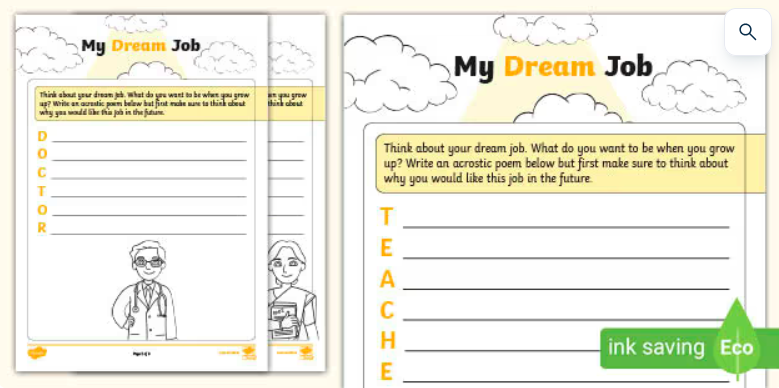
Write an acrostic poem below but first think about why you would like this job in the future, screenshot [8] Keita Translate: Conform to this boilerplate but first think of ways to justify your illusion of a choice.
No kid in grade school will write down “I will sit down at a computer all day” when asked what their dream job is. And yet office workers are a catch-all workforce [7, AMS Job description of Bürokaufmann/-frau].
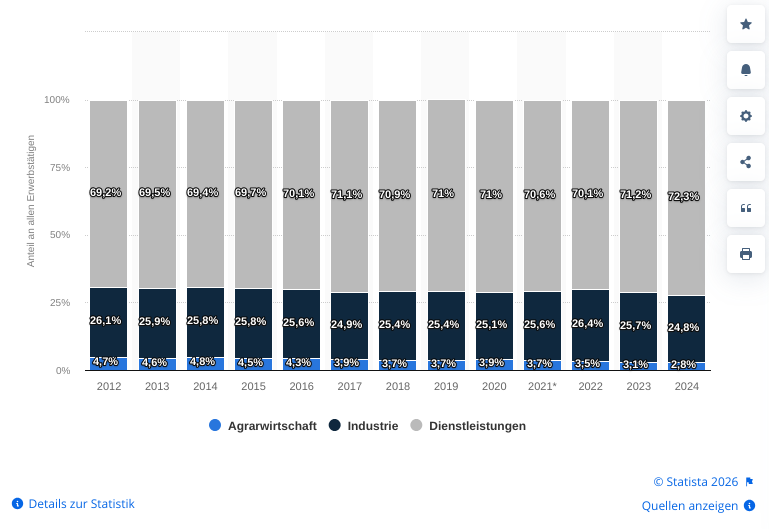
Distribution of employed persons sorted by economy sector, tertiary sector here called “Dienstleistungen” in light grey, screenshot [6]
In Austria 2025, the tertiary sector as a whole employed 2.9 million individuals. [1] As such the tertiary sector makes up almost 75% of all employed persons of all three sectors.
While “Office workers” cannot be separately defined, my assumption is that the tertiary sector is almost entirely comprised of them. Precise numbers have yet to be found and can affect my research greatly.
Imagine a world where offices have been made obsolete.
How could a world that fully decommissioned office workers adapt, and what futures do the laid off workers have?
Why?
The introduction of AI is put to blame for mass layoffs in industries already [2].
Although at the same time they are under scrutiny for their ethics, performance, and ineffective use, as around 95% of all AI pilots at companies fail [3].
A manual worker disinfects handrails on the Yamanote Line[4]
During the COVID-Lockdowns office buildings already experienced a sharp decline in use, prompting alternate use cases for the then unused buildings.
I want to investigate the knock-on effect a decommissioning of offices would have on the employees, society, architecture etc.
How?
For this I want to conduct research through questionnaires aimed at people working in offices, and literature on relevant subject matters.
What?
A final product I imagine is a short film which communicates my findings.
Soph has the suggestion to combine both worlds into one, a world where AI blackboxing has been taken to the extreme, and a tinkering subculture, or community or even public becomes a form of resistance and the way humans take back control.
NOTE:
This blog collects all assets and ideas still relevant. This means some places will repeat information from previous blogposts.
The opening statement shall be:
Because of the complexity of AI, blackboxing has been taken to an extreme. The general population has learned helplessness towards technology. However, a subculture of tinkering persists. Tinkering has become a form of resistance and way for humans to take back control.
Storyboard, script, dialogue
A draft of a script, in development parallel with visual storyboard. This is the text and dialogue side. Images added afterwards.
The situation:
Money is gone, but not yet forgotten.
Megacorporations act in the interest of obfuscation. Officially for protection of privacy.
Many common people do not agree with this approach, currently campaigning for and working towards open source hardware and software.
Most common people know how to repair common appliances. Many more advanced tinkerers are active as modders while their activities remain unregulated by law.
Scenes to incorporate:
Living room and mother repairing appliance
Dinner table
Hec interacting with a computer
Train station/place of commute?
Dialogues mentioning more world details, like education, freetime, The Great Solve, …
Characters:
Mother
Likes to keep old tech
Knows of the world before The Great Solve
Hectavia, child
Tweens, in higher education
If they don’t like something, they’ll do something about it
Goes on Hacker sites on freetime
Inherited Mom’s knack for tech
HOME INTERIOR - EVENING
The about 30m² room is a mix of a living room and a workshop shed, with couches and lamps sharing space with soldering stations and 3D printers.
A mother is sitting at the workbench and is working on an appliance on the desk in front of her, opened, with wires and circuit boards visible.
She has closed all blinds to the windows and is working under lamplight. She is wearing a headgear of some sort.

The door behind her opens, and a person dressed in outside wear walks in - her child, Hec.
HEC
- I'm home

MOM (focused)
- Welcome home

HEC (hanging jacket on hangar)
- Don't you wanna open the windows?

MOM (pausing work, facing backward)
- I don't like getting distracted when I'm in the flow

HEC (looking at workbench)
- Our oven broke? Why don't we get a new one? It's so crusty...

MOM
- Nuh-uh this one stays, I regret throwing out the old analog one.
DINNER TABLE - EVENING
Mom is sitting with Hec at the dinner table, and they unpack their meal packages they have just heated up in the now fixed oven. The room is cozy lit and in the background the 3D printers can be seen working.

HEC (chewing)
Mom, I wanna run openware on my main PC, the OS is so annoying.

MOM (also chewing, swallows and pauses a moment)
I mean, I have nothing against that but I don't want you to get too comfy with that, who knows what will change that makes running it tedious again.

HEC
But I only use it for homework, I've never seen engineers use it!

MOM
Look, don't be too reckless with it. I don't want the corpos finding out about the pirated stuff. Remember the whole adblock fiasco in the news-

Hec rolls their eyes.

MOM
Yeah it gets annoying. But its for your education. Feel free once you have the grades.
HEC'S ROOM - DUSK
Hec walks into their room - a 15m² closet resembling a capsule hotel room. The bed doubles as the desk chair to save space but still takes up half the space. A large window takes up the far side wall and is letting in the last reds and blues of the day. Hec dumps their backpack in its landing spot and sits down on the bed, turns on the PC.

Hec is navigating various dull technical websites, it appears they are looking for a user manual, when a series of ads pops up. They mostly obscure each other but the contents vaguely remind of gender-affirming fashion, hormone pills and the sort, all in flashing colors. Hec nimbly clicks through all of them, muscle memory. The ads disappear, then a notification with the score pops up, and disappears.
Hec's eye twitches in irritation.

On the desk where Hec is sitting, a small electronic device lays open, with wires and circuit boards visible. Next to it a small paper note with large, aggressive hand-written letters spelling 'HOMEWORK'.
Hec shuts down the PC, turns off the lights, slumps down onto the bed and pulls out their phone. They're playing a
circuit simulator game. It appears dealing with electronics is not the difficulty of theirs. An update prompt pops up. Hec promptly shuts off the phone and dumps it onto the desk.
DREAM SEQUENCE
An abstract series of disjunct activities play forth, mainly in FPV. The rush ends at the sight of a PC display jarredly in the middle of the street. The audio tenses up, a cold chours of breezing wind halling. A familiar logo flashes up.

Cut to view of Hec's face. They're staring at the pc display behind the audience. The expression is a intense mix of exhaustion and puzzled anger.

The audio cuts out. Without a voice and glossolalic articulation, the abstract thoughts form a question, visible as a subtitle: "Why are you like this?"

Cut to PC display, closeup. The previous audio returns, intensifying. The display starts showing a rapidly expanding wall of text in a foreign script.

Cut to Hec in bed, morning. The sound turns out to be the heating system.
HEC'S ROOM - MORNING
It's weekend. After a slow morning and breakfast Hec sits down at the desk and turns on a different PC. The display briefly flashes 'OPENWARE'. Hec logs in, opens a chatroom on the device and starts typing. They're discussing the newest chip hacks and recently decrypted keys. Hec is specifically interested in jailbreaking their phone.
-> More roles and impacts of AI
-> Friction and contrast between Blackbox and Open realm
HEC'S DESK
Camera frames the phone, plugged in. The standard boot display is visible, then switches with the OpenMobile boot screen. Hec's eye glances over in excitement.
Corpos catch up with Hec’s activities…
Megacorpos
Originally, there was going to be only one company/logo.
Soph pointed out that this would be too 1984-esque and distract from the plot. So here are 3-ish brands for variety.
MESA
"Mesa
Enterprise
Silicon
Alliance"

Black silicon Megacorp
KAN/I
"Kan-i" or "Kan-i seimitsu so-chi"
transl. "Sweet-well precision devices"

Sensor Manufacturer
Military Subcontractor Megacorp
Alpine Optics
"Alpine Optics"

Optics Manufacturer
BALUS
"Balus"

Data Aggregator Megacorp
Just like Palantir bases their name off the seeing stones from Lord of the Rings, BALUS bases its name off the famous self-destruct word from Castle in the Sky.
I’m free to take the story wherever I can, it doesn’t have to be perfect. If I cant stick to the no money and no jobs aspect, that is okay.
My pandemic experience is a good starting seed because through that experience I can tell the story closer to my expression.
The pandemic was a case of massive routine disruption. What if in a future world something artificial is expected to be reliable and it suddenly isn’t? (power grid, information system, internet etc.)
My struggles are mostly based on financial difficulties, doesn’t a future world of no money and no jobs basically evaporate all relevant aspects of my story? -> Not directly: The different struggles birthed different values between different people, and these values could persist if a solved world is young.
To work out this last bullet point, I am reading a chapter from David Graeber’s book Debt – The First 50.000 Years.
In particular I want to figure out if currency is a naturally emergent system in a large society. If yes, this means in The Solved World, communities would start enforcing a currency system despite the System not necessitating one. If no, a population could be at the whim of a system which nourishes them, deeply impacted by its instabilities.
The Myth of Barter
Although debt must have developed directly with money, it is hardly discussed. Most historic accounts from around the world only talk about the coinage and not the underlying credit arrangements. [p. 21]
Economists generally speak of three roles of money: medium of exchange, unit of account and store of value. [p. 22]
Case, Fair, Gärtner and Heather (1996): ‘A barter system requires a double coincidence of wants on both sides.’ ‘Money eliminates such logistical challenges.’ [p. 22-23]
The case of barter as an example is merely a fantasy exercise of economists explaining money. There is no proof it happened this way. [p. 22-28]
Yet the story of barter is perpetuated unanimously. It has become an essential myth without basis and propagated to people far and wide. [p. 28]
Troughout this chapter Graeber criticizes the narrative economist books regurgitate when they explain the origin of money, a form of supremacist narrative. He takes issue with all of the literature essentially imagining a money-less world by starting with a typical economy and “plucking” the money away from it.
For historical reconstruction purposes it is problematic since most people grow up with this information, saying that first was barter then came money. A conceptual precedent which interferes with archaeological research.
For imagining a near future world without money though, it is an interesting idea, since the people will be living in a world from which money was suddenly (or gradually) plucked away.
Not so relevant idea: A semi-financial life model
A semi-financial life model:
The thought of a population at the whim of a nourishing System pops up an interesting monetary system: intermittent abundance.
To those citizen living in the outskirts, the eternally abundant system is not available. They live with a finance system more similar to our financial system.
But when the state can spare material, this excess is dispersed into the outskirts.
The outskirters live with a system of intermittent money-less phases.
Storyboard – Plot 1
Characters
Protagonist:
Hector/Hectavia – Hec
Tweens age citizen.
Underground Tinkerers community member for a few years.
Works within state as small systems assembler, common occupation.
Delivery car:
State-owned asset.
Delivers every amenity to living complex of Hec’s location of residence.
The State:
Barely seen or explained within the film?
Surveillance-authoritarian?
Relatively young system, enforces a radically different economy model.
The situation:
Money is gone, but not forgotten.
People share and barter for tools and resources.
State outskirts are unfertile and uninhabited.
Story/Notes
‘One past’s trash, another future’s treasure.’
Hec lives a routine life as system assembler at the state’s productive zones (PZs). Tasks as system assembler include final assembly and quality assurance of small and medium scale robotics and electronics for the state. It may sound like a ‘Job’ at first, but the occupation can be thought of as compulsory, like education. There is no financial reward. Instead, as a PZ member they benefit from amenities like hygiene, food and shelter. What the machines are for is unknown.
A few years ago Hec came in contact with a few people while at a scrapyard outside who shared a mind: why discard the old machinery? Hec remembers the age of global finance and the struggles they had in the family before the great solve, so they have an instinct for resourcefulness and keeping things around.
With a combination of the skills acquired as PZ member and freetime tinkering with found scraps, Hec is convinced a more resource friendly lifestyle is possible for the common people, if they just knew how to fix machines.
As it stands right now, a combination of complexity in consumer products and the inadequate education of the general population leads to a large amount of electronics being discarded into landfills.
Storyboard – Plot 2
Characters
Protagonist:
Hector/Hectavia – Hec
Tweens age citizen.
State:
Recognizes hackspaces and education on electronics.
Situation:
Tinkering is a common activity, thanks to initiatives and efforts.
Story/Notes:
A setting where common people know how to modify electronics and fix machines.
This is in contrast to today’s public’s stereotypes and misunderstanding of hacking. The kind of prejudice which outlaws educational devices like the Flipper Zero.
I had a talk with Martin about how I could progress after the midterms (thx Martin <3) and him and Niko both agree that what I need to figure out is storytelling, since that is where I have the most trouble according to outside observers.
I do agree that storytelling is hard, the challenge for me is filtering the relevant details and leaving out the unnecessary.
So Martin mentioned the rough outline most movies take when they get developed:phases of money-less
Plot
Treatment
Storyline
Scenes
Film
The plot is the rough premise of the film, whats going on?
The treatment is about distilling the interesting and relevant parts from the plot for the film.
The linear storyline is then formed from the treatment.
The scenes are selected through which the storyline will be told.
The film is finally the sequence of scenes.
Martin also recommended that I use a character through which I can tell the story while I explore the world and setting, where if something doesn’t work it can be rewritten.
Calling things names
A powerful weapon of our human mind is our ability to give objects, phenomena, patterns etc. names by which to distinguish it. By giving them names they become tangible for thoughts and communication.
– Me, ask Maria about it
To know the word toxic masculinity
In highschool, before I knew the term 'toxic masculinity' I wasn't aware it was its "own thing".

I wish I knew the phenomenon as such and to recognize it among my classmates.

Instead my understanding was "I just don't fit into the class" or "the boys are being homophobic" or "that's just testosterone" - the phenomenon was aggregated across multiple different vocabularies and not tangible on its own.

That doesn't mean 'toxic masculinity' is a phenomenon with absolute and certain existence, but it is just one of the many things we have given names in our navigation of life.
The various ‘things’ I want to name don’t have inherent names, so I have to give them vocabulary so I can refer to them as their own things. This enables me to refer to them efficiently and forms a basic vocabulary for the plot.
To avoid confusion between actual terminologies and fictional terminologies within the universe, real-world information is [placed in brackets].
Blackbox-Tech
Blackbox-tech (Noun.)
1.: Umbrella term for all technologies and technology adjacent practices characterised by an intentional design towards making the products unserviceable by end-users.
It is an advanced form and alternative term for the [closed-source software and hardware practices].
Similar terms include:
Blackbox (shorthand term, not to be confused with [aircraft blackboxes])
Locked hardware
Monolith
‘Apple’s favorite son’
Black Silicon
Black Silicon (Noun. Combination of Blackbox and Silicon)
Sometimes shortened to BS (derogatory).
1.: Refers to the IC chips used within most blackbox tech. [Their identification may be obfuscated and reverse-engineering is near-impossible, with the intensive process of die photography only allowing basic layout analysis.]
2.: More broadly techniques and microdevices with the function of obfuscation. Less technically correct term but also common among most [social bubbles].
Similar terms include:
Blackbox (not to be confused with [aircraft blackboxes])
(Silicon) Key (referring to the hardware activation key often saved within the chips)
Monolith
Terminology Directive
Hereby effective within all Productive Zones as defined in the Internal Economic Management Zones Index, the Terminology Directive, scedule I, is the terminology and vocabulary guidance intended for application and development within PZ’s for and of all productive equipment.
The Terminology Directive scedule I is intended to be the adherence guide for all conscious members cleared for economic activity and ensures a clear and concise communication pipeline between all system members within PZ’s.
Terminologies deviating from Terminology Directive guidance is discouraged due to their potential to degrade information integrity.
The “Terminology Directive” gives a authoritarian twist to the worldbuilding narrative which I am not sure is relevant.
Fixable
Fixable (Noun. Combination of ‘fixing’ ‘to fix’ and ‘-able’)
1.: Umbrella term referring to machines and devices characterised by their repairability.
Fixable (Adjective. Origin same as above.)
2.: Term referring to the repariable nature of said machines and devices.
Used primarily in the tinkerer social bubble.
Similar terms include:
Oldtimer tech (Misnomer. Implies manufacture before The Great Solve, but Fixables continue to be distributed)
Green Gold (Refers to the green trace mask found on older PCBs)
Cracking
Cracking (Verb.)
1.: The activity and process of reverse engineering or deobfuscating blackbox-tech. Colloquial term.
2.: The activity and process of retrieving hardware activation keys from system management chips. Colloquial term.
The adjacent professional process carried out by personnel is called ‘unlocking’ or ‘recovery’ (per Terminology Directive).
Hacking
Hacking (Verb.)
1.: [The activity and process of dismantling, analyzing and modifying] fixables and other assorted devices.
2.: [The activity and process of infiltrating digital systems for the purpose of observation, testing, espionage, data extraction etc. Activity may be distinguished into ‘white hat’ and ‘black hat’ activities, with ‘white hat’ hacking referring to hacking with benevolent intent and ‘black hat’ hacking referring to hacking with malicious intent.]
Similar terms include:
DIYing (adjacent to 1st meaning)
Cracking (adjacent to 2nd meaning)
Personnel
Personnel (Noun.)
1.: Inexact colloquial term for civilians with Productive Zone Activity Clearance. Professional term is ‘system member’ (per Terminology Directive)
Similar terms include:
Engineer (derogatory)
[Employee] (misnomer referring to pre-solve time monetary employment systems)
Tinkerer
Tinkerer (Noun.)
1.: Person involved in the activity of [Hacking, more specifically the dismantling, analysis and modification] of fixables and other devices.
Similar terms include:
Tin-cans (derogatory)
[Hacker] (referring to by the tinkering aspect of the term hacking)
‘Persons with potential to unauthorized activity’ (per Terminology Directive)
The terms listed here have varying degrees of relevance and may be removed or expanded upon depending on complexity needs.
The Plot
Most devices the common person come in contact with are monolithic in nature and are not intended to be tampered with.
A world where…
Money is changed beyond recognition
Jobs are changed beyond recognition
Complex systems and machines are everywhere, intended to be not understood by a regular person
World questions
Does the governing body surveil and censor?
What are some laws and restrictions?
Is there “lost technology?”
The Protagonist
Active tinkerer
“who throws this away?”
knows of the world before the great solve??
Knows to take apart and modify complex systems
World inspirations
Ghost In The Shell (1995) -> Cyberisation of everything
Protagonist Motoko Kusanagi’s cyborg body (high end state/military tech) in assembly. Most people dont have/cant afford cyberized upgrades (cyborg limbs) but usually have a “cyberbrain” – electronic enhancements for the brain for direct internet access, communication etc.
The spreading of cyberbrains among the masses makes common people subsceptible against hacking.
Adaptation for my story
Invasive and complicated blackbox-tech is spread among people like phones today, enabling the post-finance-labour economy, but it comes at a cost.
Nausicaä of the Valley of the Wind -> Lost/old/traditional technologies persevering
Translation: “engine harvesting is not the priority right now!”
Background: Engines (used for airplanes) are a lost technology, the only options are harvesting from old machines or mining from ancient sites, a catalyst for territorial and resource disputes.
Adaptation for my story
Old simple and/or hackable electronic tech is a lost technology, only found in valuable scraps
My own technofantasy world – creatively named “Altras”
This is a freetime fantasy worldbuilding project I had kicking around from back when I was involved in a roleplaying group and deeply enamored with the idea of writing my own world setting. It dates back to around 2018.
It incorporates my nostalgia for Japan’s futuristic cityscape, an “all governing authoritarian AI system”, cool flying vehicles, industrial gigantism, and other interests which were relevant to me at the time. The premise of this universe is not very original and largely derives itself from Homestuck, especially the social hierarchy aspect.
It is also an example of when I was overly ambitious in writing an original world, having absolutely no idea what to do with it other than adding to it to fill a void of nostalgia I had for Japan at the time. This left the whole project direction- and meaningless. A visual manifestation of it could be interpreted in the faceless buildings and lifeless streets.
I bring this world up here because I want to use it as a bad example in many ways and want to learn from its failings so I do not end up making a similarly lifeless world.
What is the story I’m trying to tell?
As I’m expanding and editing this blog I realize that I have not internalized an official reason for going in this direction. But as I expand I also notice that the details I add carry a cynical undertone on the current development of technology, and my speculation of its development in an authoritarian direction. (I am close to playing into the conspiracy theory flavor of technology no less, despite my dismissal of its unfounded claims with problematic backgrounds.)
Should this be a story about a small underground movement against the regime? Doesn’t that sound too cliché? This kind of self doubt leaves me spiraling in a creative rut every so often.
Giving the world a body
Rambling…
To break out of this spiral I need outside input. Taking the rapid prototyping approach, trying imperfect ideas rapidly helps more than giving in to perfectionism. Having conversations with people is healthy for a reason.
I want to collect feedback and impressions from others on the setting and direction I am going in. Professionally of course I talk with the tutors periodically, but the lack of progress is humiliating and in my case sometimes leads to me inflating claims or improvising too much.
With the fellow students in a casual setting I feel less tension and performance anxiety, and seeing them daily helps with rapid prototyping. In order for me to be able to test the ideas and collect feedback, the world as a whole needs a working body, that is, I can’t collect good feedback if my question goes “in a speculative world setting I want to tell, do you think mentioning the authoritarian regime makes sense?”
For a start I will derive a boilerplate world with mostly undefined and default conditions and graft the key ideas in, focusing only on collecting feedback around the key ideas and potential interactions and questions that arise.
I could just answer the questions for myself, but this leads to a kind of hyperfocusing and incomplete story not unlike what happened to ‘Altras’. Engaging in a conversation settles down my mind in a slower thinking pace, preventing unnecessary rabbit holes like the last four paragraphs.
So here goes: In a future where big tech has expanded their power in the world economy through data aggregation, but in a future where extreme authoritarianism has not yet brought about the end of humanity as a whole.
Our protagonist, [name to be determined], lives a less normal life among the civilians. They have recently found a community of Tinkerers, and using their skill acquired from years of technical interest, now regularly visits their activities, among other things disassembling decomissioned equipment and learning their insides.
‘My dad always rambled about how back in classic times, families had their professions. That’s where they got their surnames from. The children inherit the business and wealth and are responsible to lead it for the next generation. Its a clear case of division of labour, where one is only an expert in one field and is left to the elements in any other field. It classifies people into one role they can be. I don’t agree with that. Why can’t I do sports, build airplanes and know my way around computers at the same time?’ – The protagonist, based on my experience